EAS Security
 EAS Gate
 Security Tag
 EAS Accessories
 Gadgets
 Convex Mirror
 Road Barrier
 Burglar Alarm
 Calling System
Coordinating Teachers and Exam Committees: An eBiddyaPro Guide for Bangladesh Schools
November 04, 2026

Coordinating Teachers and Exam Committees: An eBiddyaPro Guide for Bangladesh Schools
A school examination depends on many people completing connected tasks in the right order. Subject teachers prepare assessments and mark scripts. The examination committee coordinates dates, rooms, responsibilities, and review deadlines. Administrators maintain the student and academic records used to produce results. When those groups work from different lists or unclear instructions, even a carefully marked examination can end with missing marks, timetable conflicts, or incorrect report cards.
Effective examination coordination gives every task an owner, an approved source of information, and a clear handover. eBiddyaPro can support that process through its academic and examination records, provided the school verifies its configuration and working procedures. This guide explains how teachers, exam committees, and administrators in Bangladesh can coordinate planning, marks submission, result review, and publication without losing responsibility between stages.
Where eBiddyaPro Fits in School Examination Management
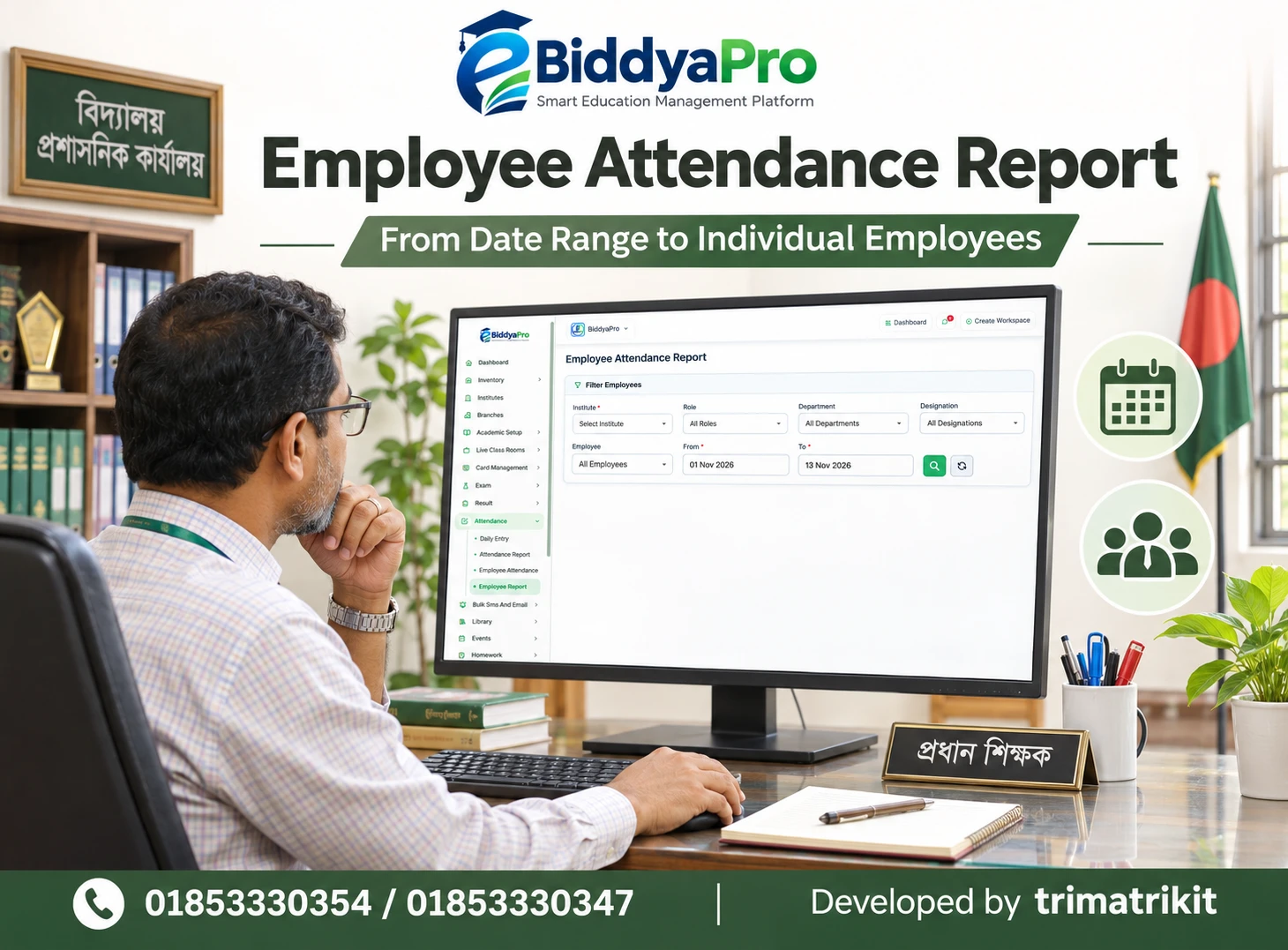
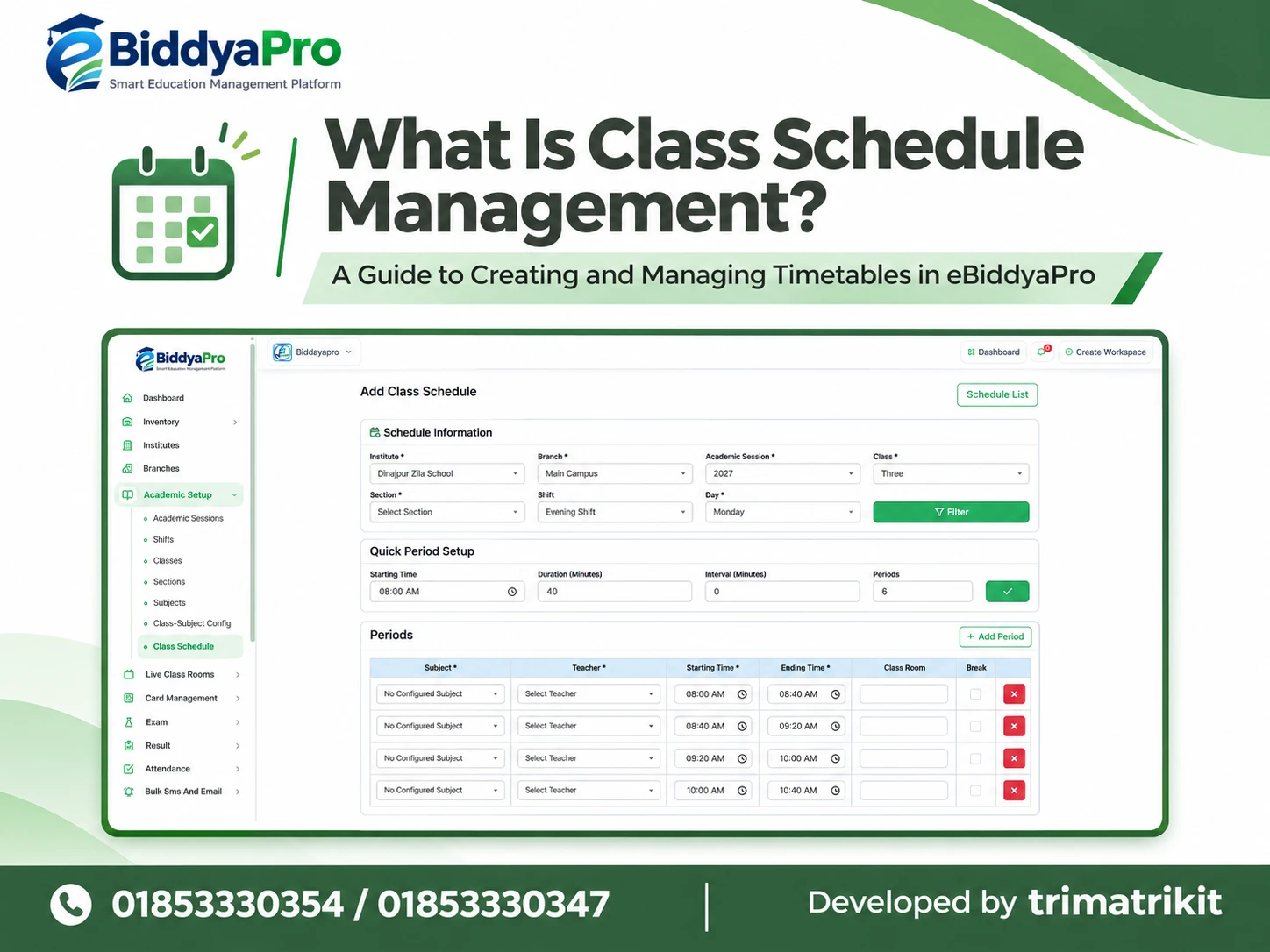
The eBiddyaPro interface shared in this discussion includes separate areas for Academic Setup, Exam, and Result. Academic Setup contains records such as sessions, classes, sections, subjects, and class-subject configuration. Those records establish the context for an examination: which students belong to the academic group and which subjects apply to them.
Trimatrik’s published eBiddyaPro guide discusses examination settings, marks entry, result processing, and academic documents. It recommends testing a complete example and checking how missing marks, absent students, and subject rules are handled. The guide also advises schools to verify document layouts and communication capabilities. These points support a practical approach: demonstrate the institution’s actual examination process before relying on the system for a full release.
The exact controls available in your workspace should determine the operating instructions. Do not assume that a menu label establishes automated invigilator assignment, approval routing, deadline reminders, or result locking. Where a required control is unavailable, use an approved supporting record and identify who maintains it.
Define Responsibilities Before Opening Marks Entry
Start by deciding who owns each decision. The academic lead approves the assessment structure. Subject teachers prepare and evaluate the relevant work. The examination committee coordinates delivery and checks readiness. Authorized administrators maintain configuration and process approved records. The person who enters a mark may not be the person authorized to approve a correction or release the result.
Consider a school preparing its half-yearly examination. A Mathematics teacher can confirm whether the marks match the evaluated scripts. The examination coordinator can check whether all required components have been submitted. The academic lead can resolve a question about the school’s approved calculation policy. Asking one person to answer all three questions can leave important checks incomplete.
Give staff a clear route for unresolved issues. A teacher who notices the wrong maximum mark should know whom to contact before entering scores. An administrator who finds an incomplete component should know whether to return it to the teacher or escalate it to the committee. These handovers should be agreed before deadlines become urgent.
Confirm Bangladesh Assessment Requirements
The school’s exam setup should reflect the instructions applicable to its institution, grade, and academic year. The Directorate of Secondary and Higher Education has published notices covering subject structures, question patterns, allocated marks, and assessment guidance for specified secondary grades. This provides an authoritative reason to review the assessment basis rather than copying a previous examination without checking its continued applicability.
The academic lead should confirm the applicable requirements and document how the school will implement them. Different education streams or grades may require different treatment. A setting used for one class should not automatically be applied to another merely because both sit an examination in the same month.
Once approved, translate the assessment plan into the relevant eBiddyaPro settings. Verify subject names, components, maximum marks, weighting, and grading treatment wherever these are configured. Keep a worked example available so staff can check that the software output reflects the approved plan.
Prepare Academic and Student Records First
Before creating examination records, review the academic session, class, section, and subject assignments. Similar names across sessions can create confusion. “Annual Examination” without a clear session and class context may be difficult to distinguish from an earlier examination when staff search or prepare documents.
Check the student roster for each assessed group. New admissions, transfers, section changes, and withdrawals can affect who should appear. Use the stable student identifier where available, and treat roll numbers within their class and session context. A student’s current section may differ from the section in which an earlier assessment took place.
Review Class-Subject Config alongside the academic plan. If an expected subject is missing from an examination workflow, first check the underlying assignment and selected context. Creating a duplicate subject can obscure the original problem and make later comparison harder.
Build an Examination Calendar That Includes the Full Process
An examination calendar should cover preparation and review as well as the days students sit papers. Give teachers time to prepare and moderate questions, complete marking, submit marks, and respond to queries. Reserve a separate period for calculation checks and document review before the announced release date.
Work backward from publication. If results are due on a particular date, the committee needs a realistic window to resolve missing components and verify report cards. A marks deadline immediately before publication leaves little time for correction. Communicate when submissions are due and what “complete” means for each subject.
Account for workload. A teacher responsible for several sections or long written assessments may need a different marking schedule from someone handling a short objective paper. A realistic calendar makes delays visible early enough for the committee to arrange support.
Check Timetables, Rooms, and Staff Assignments Together
An exam routine can be valid for each class while creating a conflict for a shared teacher or room. Review the plan from several perspectives. Students need an achievable assessment schedule. Rooms need sufficient usable capacity. Invigilators need assignments that do not overlap.
In a school running morning and day shifts, use actual clock times when comparing duties. Period labels may differ between shifts. A teacher finishing one examination may also need time to hand over scripts before taking another assignment. If practical assessments require a laboratory, verify that the room and equipment are available for the whole session.
Where eBiddyaPro does not provide the required room or staff planning control, maintain an approved companion schedule. Keep it tied to the same examination names and dates so teachers do not receive conflicting instructions from separate documents.
Establish a Consistent Marks Submission Standard
Teachers should know what information to submit and how exceptions are represented. A score of zero, an absent student, and an unentered mark are different records. Replacing all three with zero can produce misleading totals and grades.
Before full entry, test one representative student and subject. Compare the source marks with the entered values, confirm the maximum marks, and inspect the calculated result. Include a boundary case where rounding or a pass requirement could change the outcome.
If your workspace supports marks import, validate the template and student identifiers before uploading a complete file. A valid spreadsheet layout does not establish that rows have matched the correct students. Check a sample after import and confirm how repeated uploads or corrections are handled.
Separate Marks Entry from Result Verification
A completed entry screen is not the same as an approved result. Subject teachers should verify marks against their approved source records. The committee should then review whether all expected subjects and components are present. An authorized reviewer should check calculation rules and unusual outcomes.
For example, a student’s written mark may be complete while another component remains blank. The committee needs to identify that missing information before the total is presented as final. The appropriate response depends on the approved assessment policy; staff should not invent a replacement value to remove the blank.
Review a range of cases rather than only the highest-scoring student. Include a normal result, an absence, a missing component, a boundary grade, and any optional-subject treatment relevant to the institution. Independently calculated examples provide a useful basis for checking the system.
Manage Corrections Without Losing the Decision Trail
Mistakes can occur even in a careful process. Define how a teacher requests a correction, what supporting evidence is needed, and who authorizes it. A correction request should identify the student, examination, subject, original value, and proposed change.
Use the available system history and permission controls where they meet the school’s requirements. If they do not, keep an authorized correction record alongside the process. Avoid a situation in which several people can change the same result but no one can explain which version was approved.
After a correction, check any affected totals, grades, tabulation sheets, and individual documents. If a report has already been shared, identify the revised version and notify the affected family through the approved channel. A corrected database entry does not automatically replace every printed or downloaded copy.
Coordinate Across Branches and Campuses
A school with several branches can use common naming conventions and review standards while maintaining local responsibility. Identify which campus owns the student record, which teachers submit marks, and whether a central academic team approves the assessment settings.
A shared examination name does not establish identical delivery conditions. Branches may use different rooms, shifts, or staff. Keep the assessment requirements consistent where required, but verify local scheduling separately.
For a smaller Bangladesh school, the same principle can work with fewer people. One coordinator may perform several administrative tasks, while another authorized person checks calculations and release readiness. The process should fit the institution’s capacity without leaving important decisions unreviewed.
Share Results Only After a Release Review
Before publication, confirm that the intended examination and student groups are complete. Inspect individual report cards and class summaries for identity, subject coverage, grading explanations, and the correct session. Check the document layout at its actual print or viewing size.
Verify how the school will distribute results. Guardian viewing, SMS, email, applications, and printed reports are separate delivery routes. Test whichever route the institution intends to use, including access for the correct child and the handling of a corrected result.
Give families a clear query process. Technical access questions can go to the school office, while academic questions should reach the appropriate teacher or examination representative. This prevents staff from making unsupported explanations about marks simply to resolve an access enquiry.
Learn from Each Examination Cycle
After release, review what delayed the process and which errors escaped earlier checks. Useful measures include incomplete submissions at deadline, timetable conflicts, corrections after publication, and the time taken to resolve queries. Compare examinations with similar scope before drawing conclusions.
Choose specific improvements. If many errors came from subject setup, review configuration earlier. If teachers submitted complete marks but reports were delayed, examine the verification handover. If parents repeatedly selected the wrong examination, improve naming and instructions.
Start with one class for the first full demonstration of the workflow. Trace it from approved academic settings through marks, review, documents, and delivery. Expanding a tested process is more manageable than trying to resolve every uncertainty during a school-wide examination.
Frequently Asked Questions
1. What is the exam committee’s main role?
The committee coordinates the examination process and confirms readiness between stages. It connects academic decisions, delivery arrangements, marks submission, review, and publication without replacing the subject teacher’s responsibility for marking.
2. What should subject teachers be responsible for?
Teachers should understand the approved assessment requirements, evaluate the work, submit accurate marks, identify exceptions, and verify entries against source records. They should also respond to academic queries through the agreed process.
3. Which eBiddyaPro areas should staff review first?
Begin with the academic session, classes, sections, subjects, and class-subject assignments. Then examine the available Exam and Result workflows in your workspace.
4. Does eBiddyaPro automatically assign invigilators?
That capability was not established by the information reviewed. Ask for a demonstration if it is required, and maintain an approved duty schedule where necessary.
5. Can the previous examination be reused?
It can provide a reference, but verify assessment requirements, student groups, subjects, and dates first. Confirm the effect of any copying function before changing historical records.
6. Why should examination names be consistent?
Consistent names help staff distinguish sessions, classes, and assessment cycles. They also reduce the chance of entering marks or generating documents for the wrong examination.
7. How should schools handle missing marks?
Keep missing information distinct from absence and zero. Resolve the cause or apply the approved incomplete-result policy before treating the result as final.
8. Should every teacher use the same calculation method?
Teachers assessing the same subject under the same approved structure should follow consistent rules. Different subjects or grades may legitimately have different requirements.
9. How can schools check grading boundaries?
Prepare independently calculated sample cases near the relevant boundaries. Compare them with the software output and confirm the approved sequence for rounding and grading.
10. Can marks be uploaded from a spreadsheet?
Verify whether your workspace supports import. If available, test the template, student matching, duplicate handling, and correction process before uploading a full examination.
11. Who should approve a marks correction?
The school should designate an authorized reviewer. The decision should be supported by the relevant assessment record and remain traceable after the change.
12. What if a teacher is unavailable during review?
Use a pre-agreed substitute or escalation route with access to the necessary source records. Avoid asking someone to approve academic changes without sufficient evidence or authority.
13. How should practical examinations be scheduled?
Check room, equipment, staffing, duration, and student group requirements together. Reserve constrained resources early and verify that other examinations do not create conflicts.
14. Should class routines and exam routines be kept separate?
Where the examination arrangement is temporary, identify it clearly and communicate when it applies. Explain when the regular class routine resumes.
15. How can multi-branch schools keep results consistent?
Use approved common rules where applicable, consistent identifiers, and a defined central review. Preserve branch responsibility for student rosters and local delivery arrangements.
16. Does producing a report card publish it automatically?
Do not assume so. Test document generation, release controls, and guardian access separately in your deployment.
17. How should parents report a result concern?
Provide a channel requiring the student, examination, subject, and issue. Review the evidence and explain the outcome without exposing other students’ information.
18. What should happen after a published result changes?
Review affected calculations and documents, identify the corrected version, and notify the relevant family. Retain the reason and authorization for the amendment.
19. Who should access examination records?
Access should match responsibilities. Teachers, coordinators, administrators, and guardians may need different information, so test permissions using the relevant account types.
20. What is the best first test before implementation?
Run one representative class through configuration, marks entry, exception handling, verification, report generation, and delivery. Include more than one type of result case.
21. How can leaders measure better coordination?
Track late or incomplete submissions, conflicts, post-release corrections, and unresolved queries. Use those records to improve the stage causing difficulty rather than blaming the final person who handled the result.
A dependable examination process makes the next person’s task clear. Teachers submit verified marks, the committee resolves incomplete cases, and authorized staff release the approved result. Use eBiddyaPro to maintain the relevant records and support those handovers, then test the complete sequence before each major release. That gives the school a clearer basis for answering both staff questions and family concerns.
Recent Post