 EAS Security
 EAS Gate
 Security Tag
 EAS Accessories
 Gadgets
 Convex Mirror
 Road Barrier
 Burglar Alarm
 Calling System
Reviewing Class-Subject Configurations for a New Academic Session in eBiddyaPro
November 14, 2026

Reviewing Class-Subject Configurations for a New Academic Session in eBiddyaPro
A new academic session involves more than changing a year label. School administrators must confirm that the correct classes are available, the intended subjects are associated with each class, and staff can identify which configuration belongs to which session. An overlooked subject or an incorrect session selection can create confusion when academic teams begin preparing their work.
For schools in Bangladesh, this review should connect the institution’s approved academic plan with the information entered in its school management software. Last session’s configuration may provide a useful reference, but it should not automatically become the next session’s final subject list.
The eBiddyaPro Class-Subject Configuration Manage screen provides a structured view of these relationships. In the supplied interface, each configuration displays an institute, session, class, associated subjects, and status. Administrators can use this view to inspect existing arrangements and identify records requiring attention.
This guide explains how to review class-subject configurations for a new academic session in eBiddyaPro, interpret the visible information accurately, and organize a practical review process for educational institutions in Bangladesh.
Understanding Class-Subject Configuration in eBiddyaPro
A class-subject configuration records a relationship between a class and its associated subjects within a specified academic context. On the supplied screen, that context includes both the institute and session.
For example, a configuration may show Class One associated with Bangla, English, and Math under a particular session. Another row may show Class Two associated with subjects bearing the same names.
These are separate class configurations even when the subject names match. A shared subject name does not mean that classes follow identical learning content, teaching plans, assessment arrangements, or textbooks.
The purpose of reviewing this page is to confirm that the recorded relationships represent the institution’s intended setup. It is not enough to see familiar subject names somewhere in the system; they must appear against the appropriate class and session.
What the Supplied Screen Actually Shows
The supplied eBiddyaPro page appears under Academic Setup, with Class-Subject Config selected in the navigation menu. The table contains columns for Institute, Session, Class, Subject, Status, and Action, alongside a serial number.
Two configurations are visible. They belong to the same institute and display the session label “2025-2027.” One row is for Class One and the other is for Class Two. Each shows Bangla, English, and Math as subject labels, with an Active status.
The page also includes a New button, a configuration search field, a Search button, toolbar controls, a page-size selector, and pagination. Edit and delete controls appear against each row.
The screenshot does not show the creation or editing forms. Consequently, it does not establish every required field, validation rule, or consequence of changing a configuration.
Why Session Preparation Needs a Separate Review
A configuration that was appropriate previously may need adjustment before another session begins. The institution might introduce a class, revise its internal subject naming, correct an earlier omission, or adopt an updated academic plan.
Without a separate review, staff may assume that existing records are ready simply because they appear complete. That assumption can leave the wrong session attached to an otherwise accurate class-subject list.
Reviewing early gives academic and administrative staff time to resolve disagreements before relying on the configuration. It also allows staff to distinguish a genuine academic change from a simple data-entry correction.
The objective is a clear connection between the approved plan and the saved records. Software entry should follow that plan rather than become an accidental source of academic decisions.
Bangladesh Context: Confirm the Applicable Academic Reference
Schools in Bangladesh should identify which official and institutional academic references apply to their programme, level, and forthcoming session.
NCTB publishes textbook information organized by academic year and educational level, including separate pages for different classes and streams. This supports checking the relevant year and level rather than relying on an undated list. However, a textbook list alone should not be treated as a complete explanation of every institution’s subject or assessment requirements.
For an upcoming session, use the applicable published guidance and the institution’s approved academic documents. A previous year’s materials can help with comparison, but they should not be presented as confirmation of a future session’s requirements.
Institutions following other curricula should use their own applicable references rather than assuming a single subject arrangement applies to every school.
Applying Research-Based Education Data Principles
Reliable academic administration depends on consistent definitions and accurate records. UNESCO’s education information system resources emphasize establishing data definitions and naming conventions as part of data quality management. These principles are relevant when schools maintain class and subject information.
For an eBiddyaPro administrator, the practical application is straightforward. Staff should agree on what a class name means, how a session is identified, and which subject record represents an approved subject.
This does not mean that eBiddyaPro is being described as a national EMIS or as implementing a particular UNESCO framework. The research provides a general foundation for careful education data management.
Consistent records make academic discussions easier because teachers and administrators can refer to the same class, subject, and session without interpreting competing labels.
Begin with the Correct Institute
The Institute column should be reviewed before examining individual subjects. A subject list can look reasonable while belonging to the wrong institution.
This matters in environments where administrators handle information for more than one institute. Similar class names and familiar subjects can make an incorrect association easy to overlook.
Confirm the full institutional identity against the academic plan being prepared. Do not rely entirely on the currently displayed workspace name or a remembered selection from another task.
The screenshot shows an Institute column but no separate Branch column in this table. Therefore, it should not be assumed that these configurations provide branch-specific control. If campus differences matter, confirm how the actual installation represents them before entering separate records.
Read the Session Label Carefully
The supplied screen displays “2025-2027” as the session label. That is a visible software value, not evidence that every school should use a session of that length.
Institutions should confirm what their session labels represent. A label might identify an institutional period, an academic year, or another arrangement defined during setup.
For a new session, verify that the intended session record exists and that the configuration is associated with it. Avoid choosing an older record merely because its name appears similar.
A useful label should be understandable to staff who were not involved in creating it. If the existing naming convention is ambiguous, resolve the convention before adding further configurations that repeat the ambiguity.
Confirm the Class Identity
Class names should be recognizable and consistently applied. “One,” “Class One,” and another variation may be understood by people as the same level, but separate software records should not be assumed to be interchangeable.
Before configuring subjects, check that the intended class is selected from the correct academic setup. If duplicate-looking class records exist, investigate their purpose rather than choosing one arbitrarily.
A class label also does not necessarily identify a section, shift, or student group. Those are separate concepts, and the supplied configuration list does not display them as columns.
Where an institution needs different subject arrangements for groups within the same class, confirm whether and how that requirement is supported. The visible table alone cannot establish that behavior.
Distinguish Subjects from Their Class Associations
The navigation menu includes Subjects separately from Class-Subject Config. This is an important distinction when reviewing an apparent omission.
A subject may exist as a record without appearing in a particular class configuration. Conversely, seeing a subject in one class does not establish that it has been associated with every class that needs it.
Before creating another subject record, investigate whether the required subject already exists. The issue may concern its association with the selected class rather than the absence of the subject itself.
This approach can help avoid unnecessary duplicates. It also keeps the review focused on the actual question: is the correct subject associated with the correct class and session?
Review Subject Names and Language Conventions
The supplied example uses Bangla, English, and Math. These labels are easy to recognize, but institutions should still agree on consistent naming.
For example, “Math,” “Mathematics,” and a Bangla equivalent might represent the same intended subject in everyday conversation. If they exist as separate records, staff should determine whether that separation is deliberate.
Use the naming convention supported by the institution’s academic records and the actual subject form. Do not change names casually when existing records may rely on them.
Where subjects genuinely differ by paper, programme, or academic purpose, preserve that distinction. A shorter list is not automatically a better list if it combines subjects that need to remain separate.
Compare the Saved List with the Approved Plan
The most useful review compares two things: what the institution intends to offer and what the saved configuration actually contains.
If the approved plan includes a subject missing from the class configuration, investigate the omission. If the configuration contains an additional subject, establish whether it is intentional, outdated, or entered by mistake.
Do not judge completeness by the number of labels alone. Three correct subjects and three incorrect subjects produce the same count but very different outcomes.
The screenshot’s three subject labels are demonstration data for the displayed records. They should not be presented as a complete national curriculum or a recommended subject package for Class One or Class Two.
Understand What Active Status Does and Does Not Prove
Both visible configurations display Active. This indicates the status shown for those records, but the screenshot does not explain the full operational meaning of that status.
Active should not automatically be interpreted as approval by an academic committee, confirmation of curriculum compliance, or readiness for every connected module.
A configuration can be active while still containing an incorrect session or an incomplete subject list. Academic verification therefore remains necessary.
If administrators need to understand whether inactive configurations remain searchable or affect other workflows, they should confirm the behavior in the actual installation. The list view does not establish those consequences.
Search Existing Configurations Before Adding New Ones
The page includes a configuration search field and pagination. These controls should be used before deciding that a configuration is missing.
Search using a relevant term, inspect possible matches, and check the displayed institute, session, and class. A record absent from the current page may still exist elsewhere in the list.
The screenshot does not establish which columns the search examines or whether it supports partial matches across every field. If one search produces no result, verify the scope before creating another entry.
Duplicate configurations can make later review harder. Preventing an unnecessary duplicate is usually easier than resolving uncertainty about which record should be used.
Prepare New Configurations Without Overwriting History
Preparing a new session should not automatically mean editing an old configuration until it looks current.
Changing the session on an existing record might have consequences for historical relationships, depending on the software’s design. Those consequences are not visible in the supplied screenshot.
Before proceeding, establish whether the institution should create a new configuration for the forthcoming session and how previous records should be preserved. The New button is visible, but an automatic session-copying or rollover feature is not demonstrated.
If a supported copying process exists, review its output. A copied configuration still needs confirmation against the new session’s approved plan.
Edit with a Clear Reason for the Change
An edit should address an identified issue. Examples include correcting the selected class, fixing an unintended subject association, or updating a configuration to match an approved plan.
Before saving, distinguish a data-entry correction from a genuine academic change. The distinction helps staff explain why the record was altered.
The supplied list contains edit controls, but it does not demonstrate automatic change history, approval routing, or version restoration. Where the institution needs an explanation of significant changes, maintain it through an appropriate documented process.
After editing, review the saved row. Confirm that the intended subject labels remain and that no unrelated institute, session, or class value changed.
Delete Only After Understanding the Record’s Role
A delete icon does not explain how deletion affects other information. Before removing a configuration, determine why it exists and whether another process relies on it.
A record that appears old may still be relevant to historical academic work. A duplicate-looking entry may also have relationships that are not obvious from the list.
The screenshot does not demonstrate dependency warnings, soft deletion, recovery, or automatic replacement of references. Do not promise those protections without checking.
If the objective is to stop using a configuration, investigate the appropriate supported approach. Editing, changing status, and deleting are different actions whose effects should be understood before selection.
Confirm Related Workflows Separately
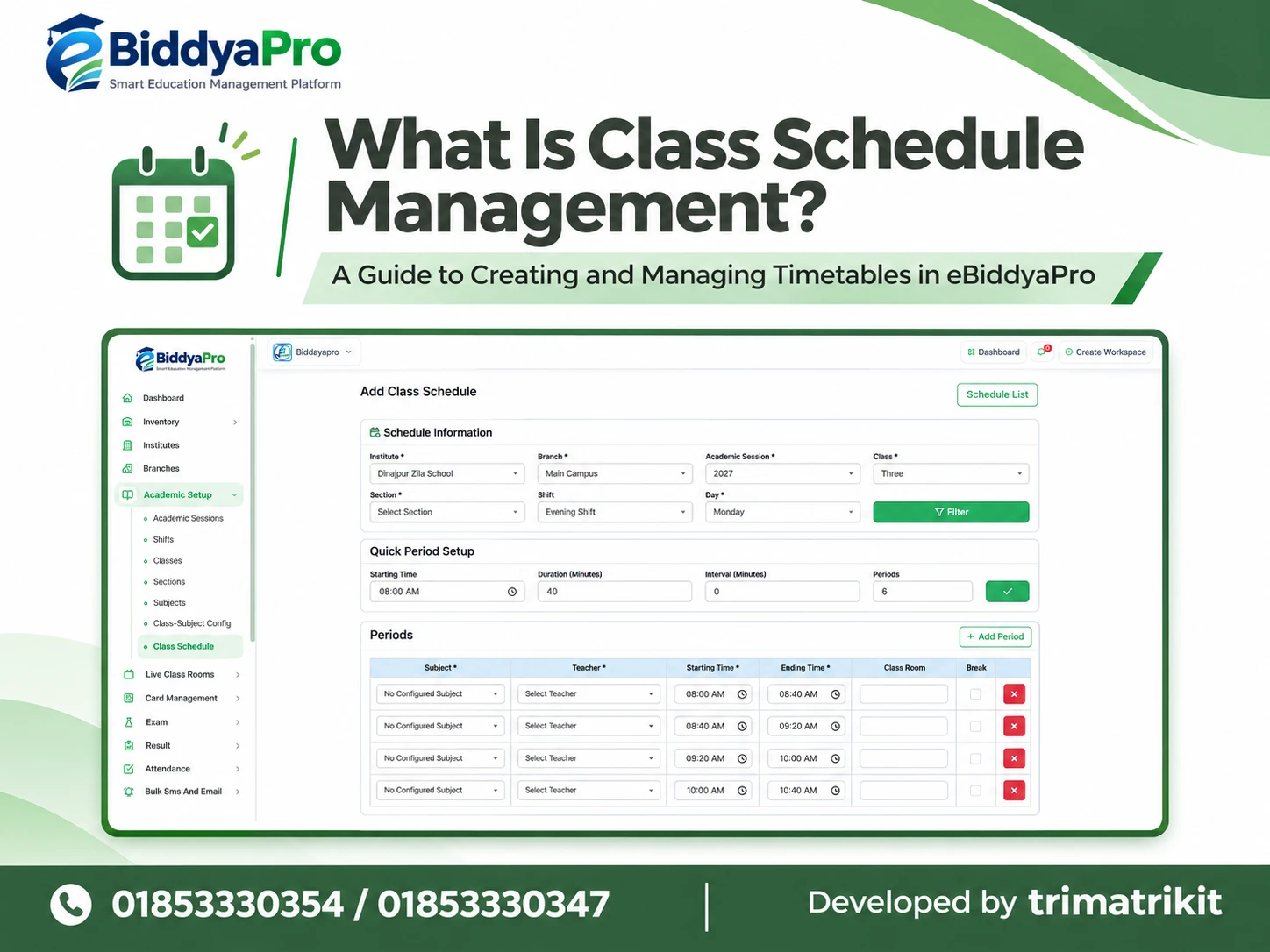
Class-subject information may be relevant to academic activities such as scheduling or assessment setup, but the exact relationships must be checked in the institution’s installation.
The navigation shows Class Schedule, Exam, and Result areas. Their presence does not prove that saving a class-subject configuration automatically creates a routine, assigns teachers, establishes marks, or generates results.
After preparing a configuration, inspect any relevant workflow that is expected to use it. Confirm that the correct class and session produce the intended subject choices.
This practical verification is more reliable than assuming a successful save has completed every related academic setup task.
Coordinate Academic and Administrative Responsibilities
A useful review involves both academic knowledge and careful software entry. An administrator can maintain records accurately while still needing a teacher or academic coordinator to confirm the intended subject arrangement.
Assign clear responsibility for preparing the proposed list, confirming academic content, entering changes, and reviewing the saved result. A small institution may combine these responsibilities, but the decisions should remain clear.
This coordination helps prevent an administrator from resolving academic uncertainty by guessing. It also prevents teachers from assuming that a discussion has already been reflected in the software.
When responsibilities change, the next staff member should be able to understand which configuration is ready and which questions remain unresolved.
A Practical Example for Session Preparation
Consider a fictional school preparing its next academic session. Its existing Class Two configuration contains Bangla, English, and Math.
The academic coordinator confirms the intended subject arrangement using the relevant approved documents. During comparison, the team discovers that one subject association needs correction and that the forthcoming session requires its own configuration.
The administrator searches existing records before using New. After saving, another staff member verifies the institute, session, class, subject labels, and status.
The team then checks the relevant academic workflow to ensure that the expected subject choices appear. This example illustrates a review process; it does not suggest that the three subjects shown in the screenshot are a complete curriculum.
Maintain a Review Record for Future Staff
A short administrative record can explain which academic reference was used, who confirmed the list, and when the review took place.
If the software does not provide suitable fields for this information, keep it in the institution’s established documentation. Do not insert lengthy approval notes into subject names or class labels.
Record unresolved questions clearly. For example, staff may still need confirmation about a subject distinction or the treatment of an earlier configuration.
This record supports continuity during handovers. It also helps staff distinguish a deliberate academic arrangement from a configuration that has simply remained unchanged for several sessions.
Frequently Asked Questions
1. What is Class-Subject Configuration Manage in eBiddyaPro?
It is the page shown for reviewing relationships between institutes, sessions, classes, and subjects. The supplied table also displays configuration status and available edit and delete actions.
2. Why should configurations be reviewed before a new session?
An older configuration may contain outdated associations or refer to the wrong session. Reviewing early helps align saved records with the institution’s approved academic plan before staff rely on them.
3. Is a subject record the same as a class-subject configuration?
No. The menu shows Subjects and Class-Subject Config separately. A subject’s existence does not establish that it has been associated with a particular class and session.
4. Does the screenshot show a complete curriculum?
No. It shows demonstration configurations containing Bangla, English, and Math. Those labels should not be interpreted as a complete national or institutional curriculum.
5. Should every school use the session label “2025-2027”?
No. That is the label visible in the example. Institutions should use session records that accurately represent their own academic arrangements.
6. Can the same subject appear in different classes?
The screenshot shows the same subject names against two different classes. However, matching names do not mean identical textbooks, teaching content, or assessment arrangements.
7. Does Active mean the configuration has academic approval?
The screenshot does not establish that meaning. Active is a displayed record status, while academic approval requires the institution’s own review and confirmation.
8. What should be checked first?
Confirm the institute, session, and class before reviewing subject labels. Otherwise, a reasonable-looking list may be accepted under the wrong academic context.
9. Can configurations be managed separately by branch?
The supplied table does not show a Branch column. Confirm how the actual installation handles campus or branch differences before assuming branch-specific configuration is available.
10. Are sections and shifts included in this list?
They are not displayed as columns in the supplied table. Their relationship with class-subject configuration should be checked separately where relevant.
11. How can missing subject associations be investigated?
Confirm the institute, session, and class, then compare the configuration with the approved plan. Check whether the required subject already exists before creating a new subject record.
12. How should duplicate subject names be handled?
Compare their purpose and existing use before changing anything. Similar names may represent duplicates, alternative labels, or genuinely different academic subjects.
13. Should last session’s configuration be reused automatically?
No automatic reuse should be assumed. Previous records can support comparison, but the forthcoming session needs its own review and the appropriate supported setup process.
14. Does eBiddyaPro automatically copy configurations to a new session?
No copying or rollover function is demonstrated in the screenshot. Confirm available functionality in the actual installation before relying on it.
15. Can changing a configuration affect historical information?
That depends on the system’s relationships and behavior. The screenshot does not establish the effect, so confirm it before repurposing or deleting existing records.
16. Does saving a configuration automatically assign teachers?
That is not demonstrated by the supplied page. Teacher assignments and other academic arrangements should be verified through their relevant workflows.
17. Does configuration automatically create a class routine?
The screenshot does not prove automatic routine generation. The Class Schedule area appears separately and should be reviewed according to the institution’s setup.
18. Which academic references should Bangladeshi schools use?
Use the guidance and institutional documents applicable to the programme, level, curriculum, and intended session. Avoid treating an earlier textbook list as confirmation of future requirements.
19. Why search before selecting New?
Searching can reveal an existing configuration and help avoid duplication. Also check pagination and search behavior before concluding that a record does not exist.
20. What should be verified after editing?
Review the saved institute, session, class, subjects, and status. Then inspect any relevant workflow expected to use the configuration.
21. Is deleting an old configuration always safe?
No. Confirm its role, relationships, retention needs, and deletion behavior first. Recovery and protection of related information are not demonstrated in the screenshot.
22. Who should confirm the final subject list?
An authorized academic representative should confirm the intended arrangement, while the responsible administrator verifies the saved software record. The institution can assign these responsibilities according to its staffing structure.
Prepare the New Session with Clear Academic Records
Reviewing class-subject configurations in eBiddyaPro helps connect an institution’s academic plan with its saved setup. The essential task is to verify the correct institute, session, class, and subject relationships before relying on them.
Consistent naming, careful comparison, and verification after changes make the records easier for teachers and administrators to understand. They also support a clearer handover when responsibility moves to another staff member.
For assistance with eBiddyaPro academic setup and class-subject configuration, contact 01853330354 or 01853330347.
Recent Post