EAS Security
 EAS Gate
 Security Tag
 EAS Accessories
 Gadgets
 Convex Mirror
 Road Barrier
 Burglar Alarm
 Calling System
Why Is an Education Management System Important for Modern Schools?
November 15, 2026

Why Is an Education Management System Important for Modern Schools?
A modern school needs dependable information throughout the day. Teachers need accurate class lists, accounts staff need clear payment records, and administrators need to understand enrollment, attendance, and academic responsibilities. Guardians also expect the institution to provide timely, consistent answers.
When these activities rely on disconnected files and registers, employees can spend considerable time locating information or checking which version is correct. A student’s name may be updated in one place while an older spelling remains in examination documents. A class transfer may reach the teacher but remain missing from another administrative list.
An Education Management System, or EMS, can help schools organize these relationships. Its importance comes from how effectively it supports institutional work, not simply from replacing paper with screens.
For schools in Bangladesh, eBiddyaPro is a platform to evaluate for this purpose. This guide explains why an EMS matters, where it can support daily administration, and what institutions should verify before implementation.
What Is an Education Management System?
An Education Management System is a digital platform used to organize academic and administrative information and support related workflows.
Depending on its scope, it may cover student records, admissions, academic sessions, attendance, examinations, fees, communication, and reporting. Different products use terms such as EMS, school management software, or school ERP, but the label alone does not establish their capabilities.
UNESCO describes education management information systems as frameworks that collect, process, and analyze educational data to support administration and planning. Its work also addresses information systems at wider education-sector levels. These principles provide context for school management; they do not certify a particular commercial platform.
A school should therefore evaluate the actual functions and responsibilities behind the product name.
Why Modern Schools Need More Than Record Storage
A record is useful when it helps someone perform an appropriate task.
A student profile supports identification. A class assignment supports attendance preparation. A verified fee transaction supports an accurate balance. A subject configuration can support academic planning.
If those relationships are unclear, storing more information may simply create a larger collection of disconnected records.
An EMS matters because it can provide a more structured way to maintain and use information. The practical benefit depends on accurate data, suitable configuration, and clear ownership.
For a school evaluating eBiddyaPro, the central question should be whether the proposed setup supports complete workflows. Looking at individual screens is a starting point, but it should be followed by realistic examples.
Understanding eBiddyaPro’s Published Scope
The supplier presents eBiddyaPro as a Smart Education Management Platform. Its practical guide discusses school administration and encourages institutions to review their requirements before choosing a setup. The published material is a product evaluation resource rather than an independent assessment of performance.
The supplied interfaces show areas such as student management, parents, academic setup, class schedules, attendance, homework, fee types, and supporting administration.
These screens help identify relevant questions. They do not establish that every module is included in every package or that every possible integration operates automatically.
A school should obtain a written scope connecting its requirements with the proposed implementation. Features demonstrated during a sales presentation should also be reflected in the agreed service.
Importance in the Bangladesh School Context
Schools in Bangladesh can have different administrative structures. An institution may operate several sections, separate campuses, or Bangla medium and English version groups. Others may provide transport or residential accommodation.
These are examples of possible requirements, not findings from a nationwide market survey.
A useful EMS should be assessed against the school’s real structure. The same configuration may not suit a small single-campus institution and a larger organization with several locations.
Practical local requirements also deserve attention. Bengali and English names, relevant academic terms, amounts in taka, usable documents, staff training, and support arrangements can influence everyday adoption.
Selecting software without testing these details can shift administrative effort rather than reduce it.
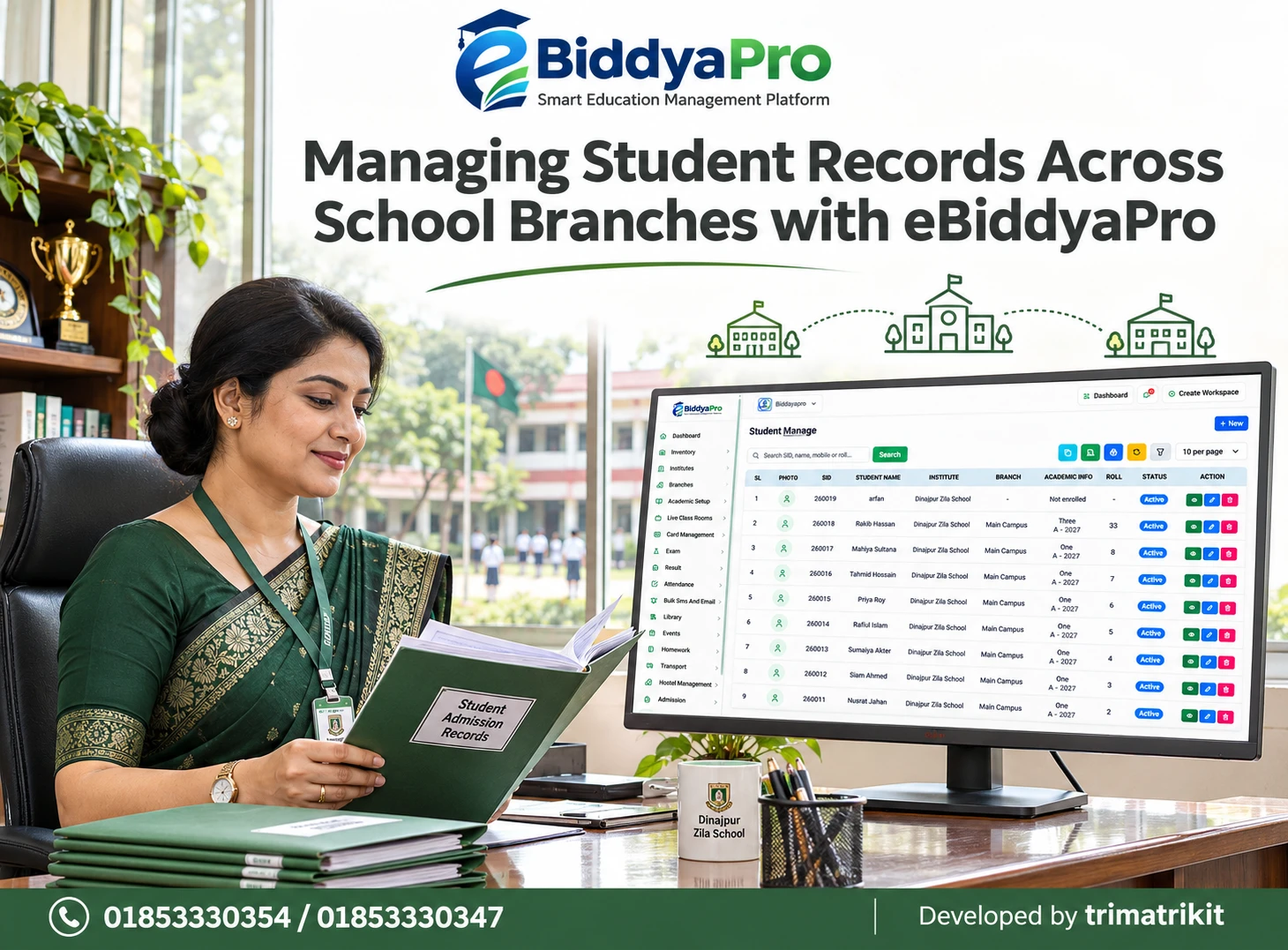
Reliable Student Identity Supports Every Department
Student identity is a foundation for connected school administration.
A name alone may not distinguish two learners. An internal identifier helps staff locate the correct person, while class, section, and roll describe the learner’s current academic placement.
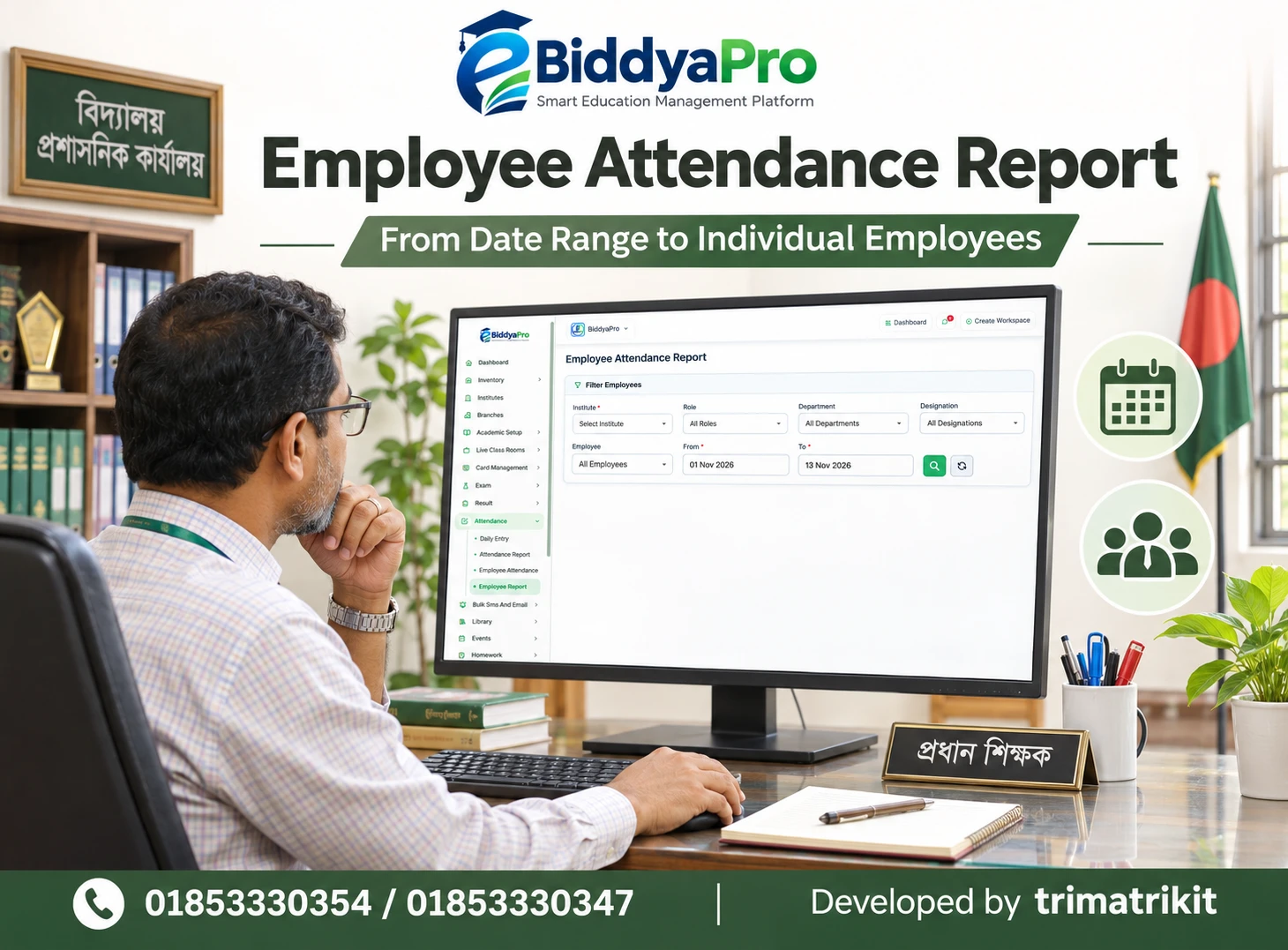
The supplied eBiddyaPro Student Manage interface displays these kinds of information separately. During evaluation, test how a student is identified after a class or roll change.
Also examine corrections. If a name is updated, determine which screens and documents reflect the change and whether earlier outputs retain their original information.
Dependable identity management helps reduce ambiguity when attendance, financial, and examination records are reviewed.
Admission Becomes a Defined Process
Admission often involves collecting information, checking documents, making a decision, and assigning an approved student to an academic group.
These stages should not be treated as interchangeable. An applicant can have a record without being fully enrolled.
An EMS can support administration when it makes incomplete stages visible and establishes who completes them. However, the actual approval and enrollment behavior must be demonstrated.
For eBiddyaPro, ask the supplier to follow a fictional applicant from initial entry to a usable class record. Inspect what information is reused and whether duplicate profiles can be avoided.
This complete example is more informative than confirming that an admission form exists.
Academic Structure Gives Information Meaning
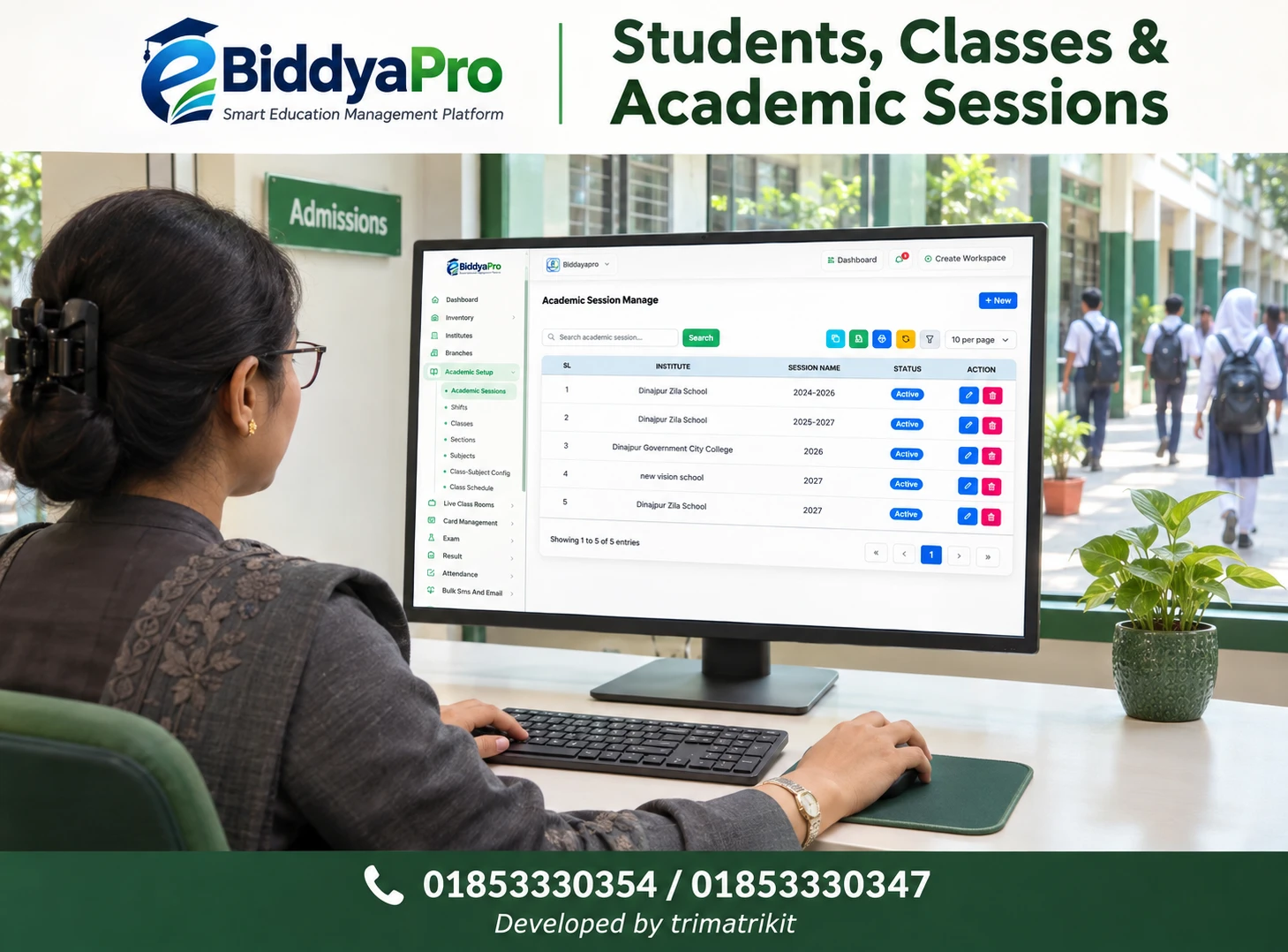
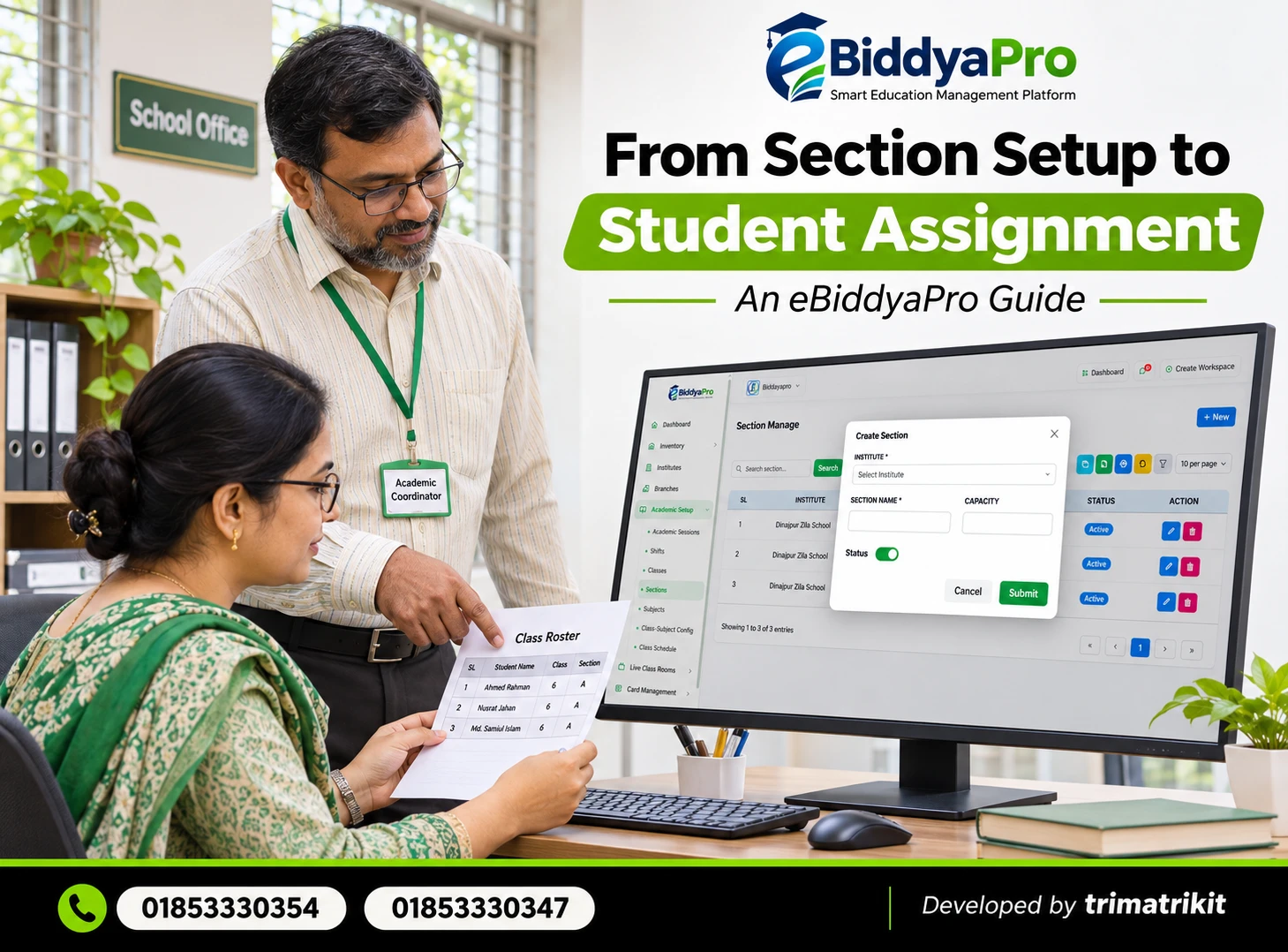
Academic sessions, classes, sections, subjects, and shifts define the context in which school records are used.
Without consistent setup, staff can select the wrong group or generate a report for an outdated period. Similar names may conceal different meanings.
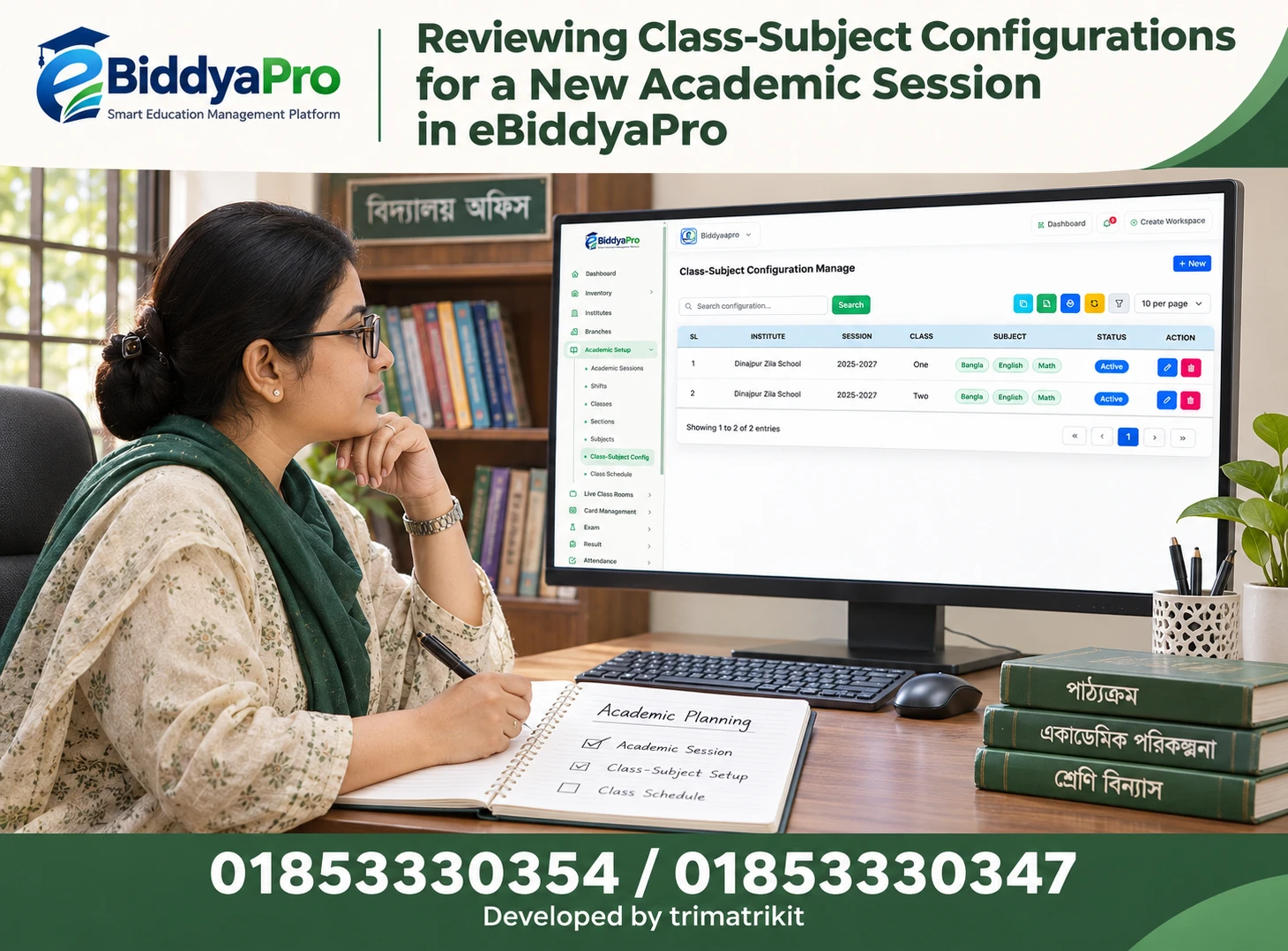
The supplied eBiddyaPro navigation includes separate academic setup areas. Schools should establish approved naming conventions and decide how these records relate to one another.
For institutions operating different versions or programs, the distinctions must remain clear throughout admission, attendance, homework, and reporting. A section or shift should not casually replace a different academic concept without evaluating the consequences.
Attendance Can Support Earlier Administrative Follow-Up
Attendance information helps staff review student participation over a defined period.
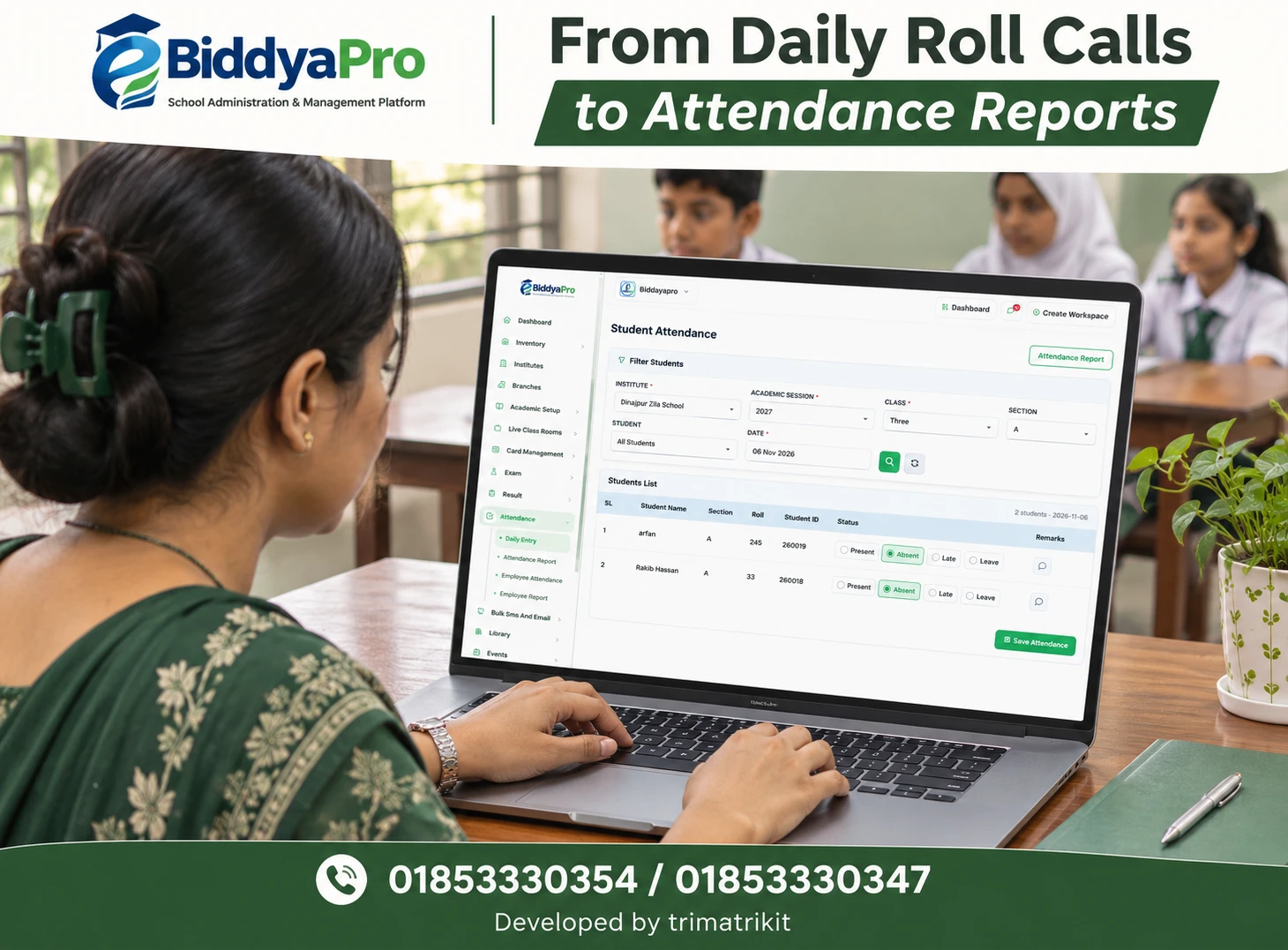
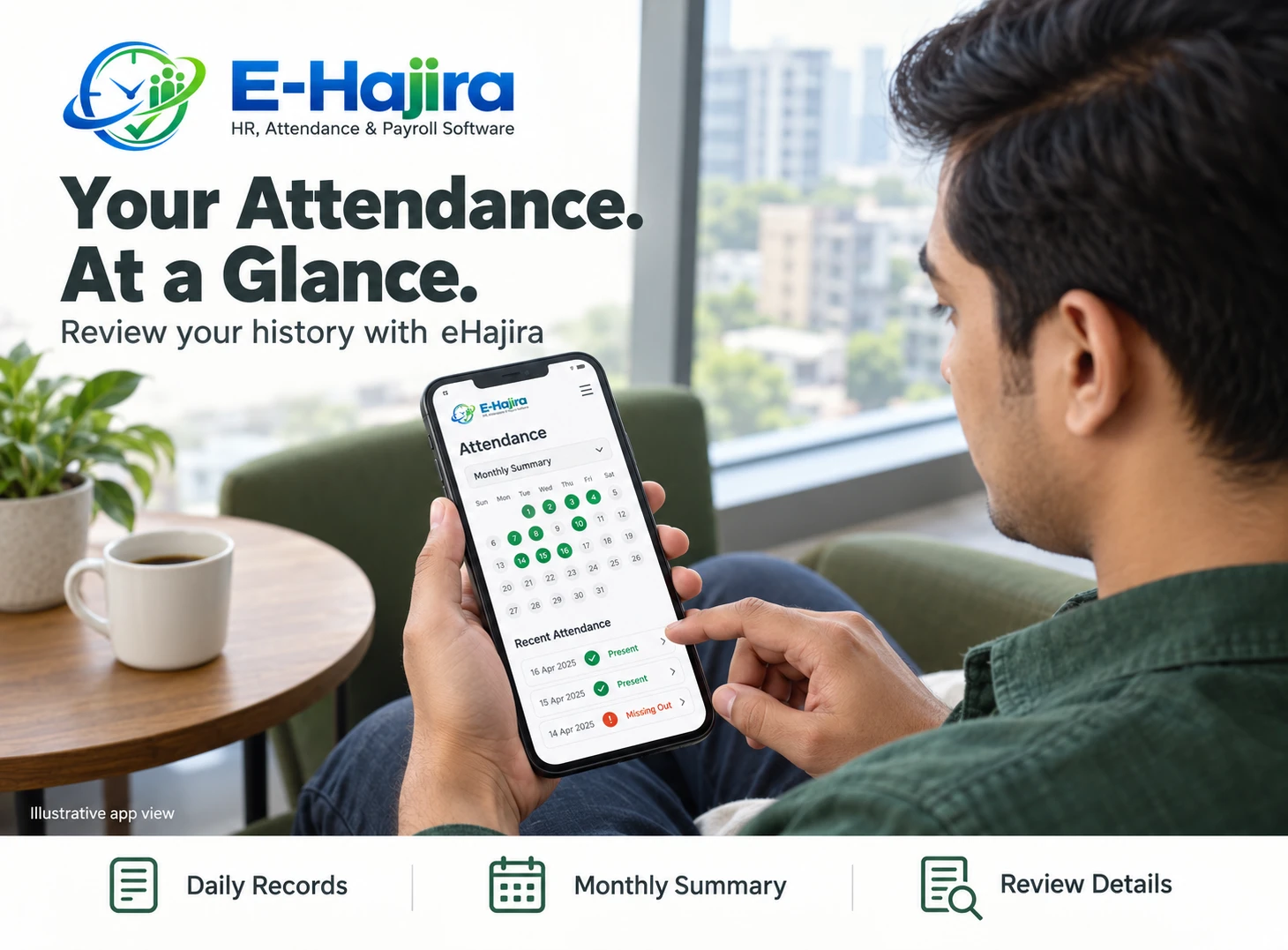
The supplied eBiddyaPro attendance form shows group and date filters with Present, Absent, Late, and Leave options. These controls can support a consistent recording process when used correctly.
However, missing information is not automatically confirmed absence. A teacher may not have completed entry or may have selected the wrong group.
An EMS is important when it helps staff locate and investigate relevant records promptly. The information should support an appropriate response, such as verification or guardian contact, rather than an automatic assumption about the student’s circumstances.
Teachers Need Practical Administrative Support
Teachers benefit from processes that make class-related information accessible without unnecessary repeated work.
A suitable setup may help identify assigned learners, organize attendance, access schedules, and manage relevant academic tasks. The exact teacher-facing functions should be tested with a teacher account.
Administrative access and teacher access are not necessarily the same. A demonstration conducted entirely through an unrestricted administrator account may hide practical limitations.
Ask teachers to perform ordinary tasks using the proposed permissions and devices. Their experience can reveal whether the system supports the working day or requires additional steps that were not obvious during the initial presentation.
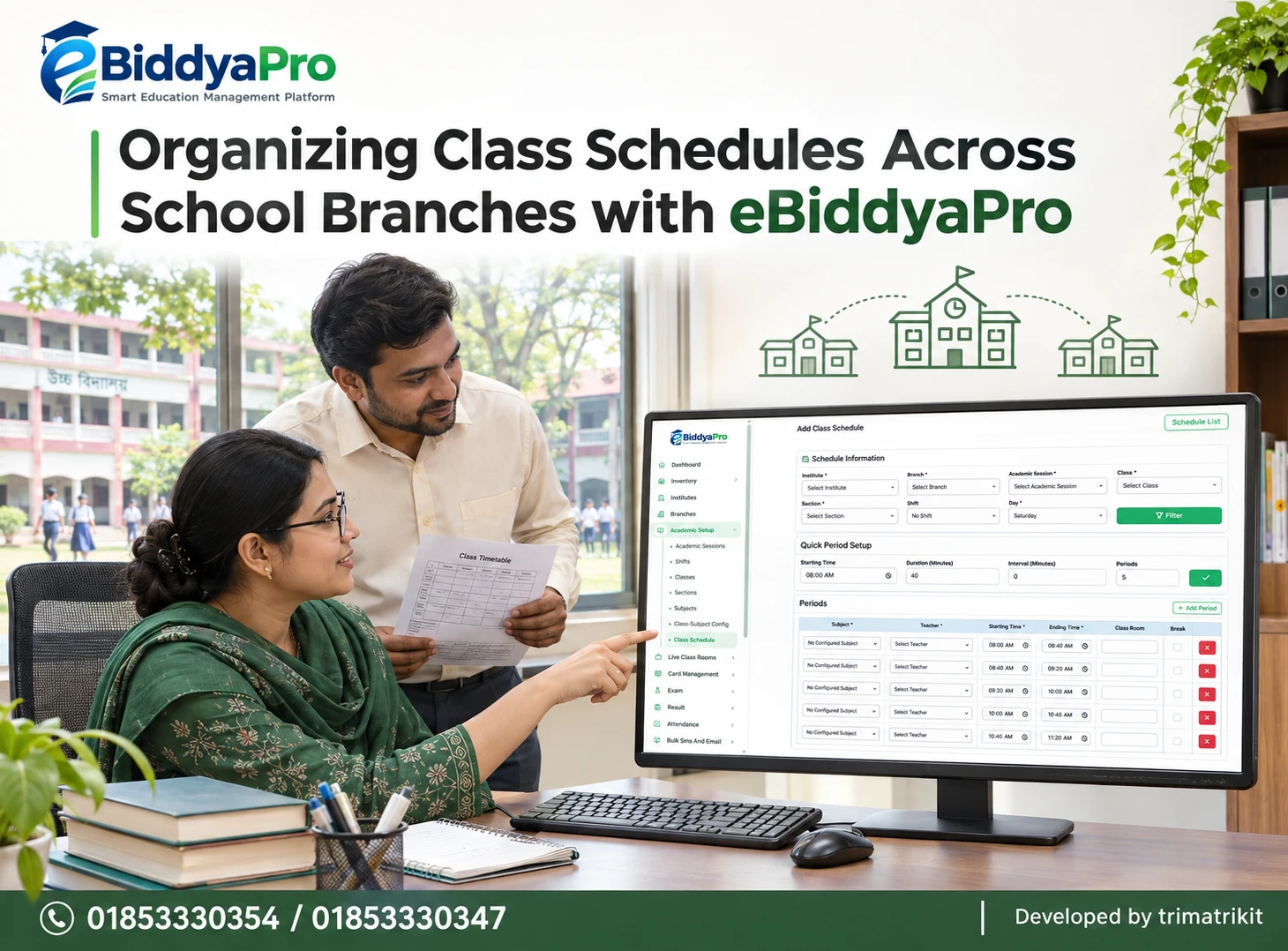
Class Schedules Coordinate People and Time
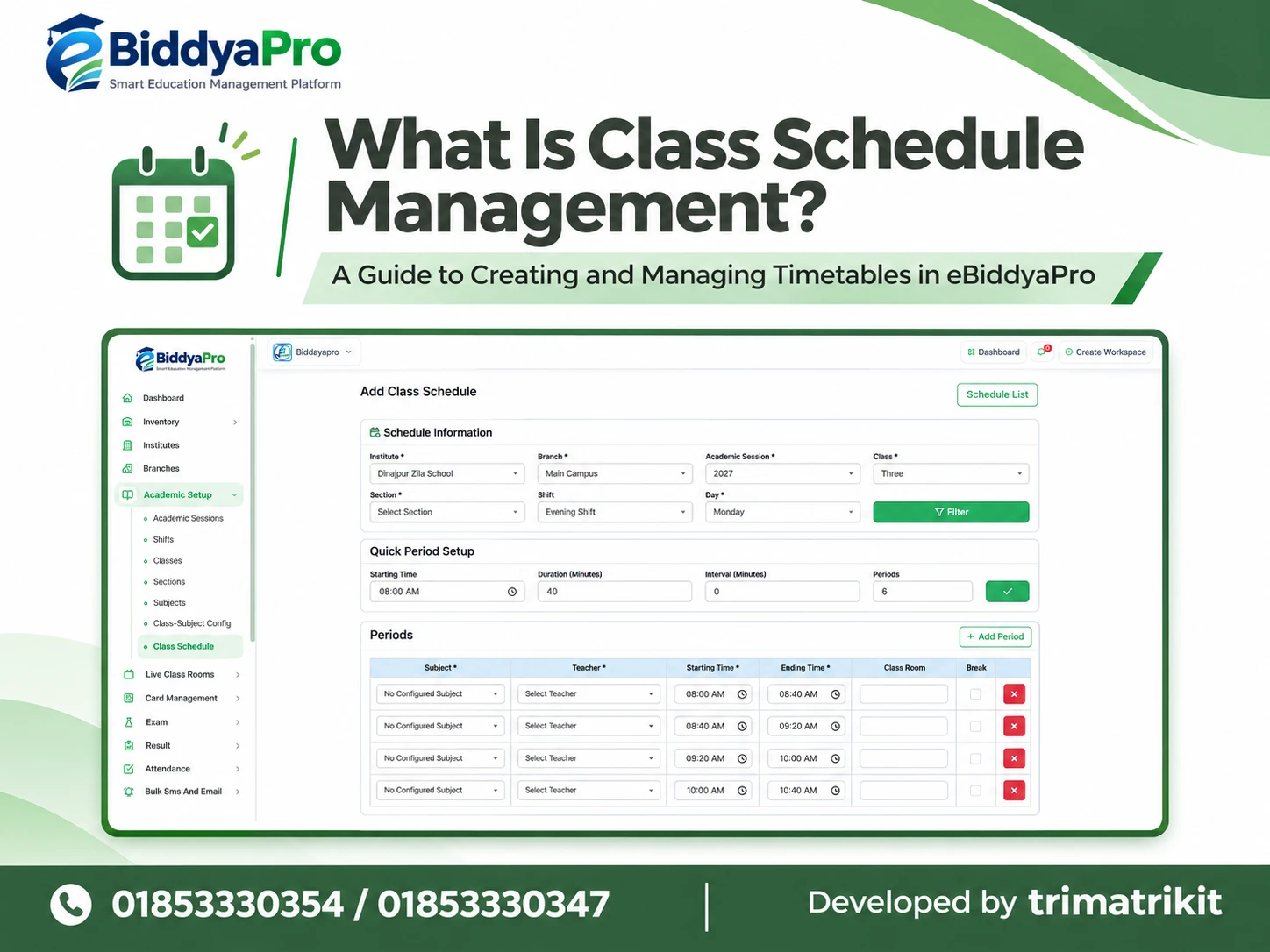
A timetable connects subjects, teachers, classrooms, and periods.
The supplied eBiddyaPro schedule interface displays controls for these relationships. It provides a basis for evaluating how the institution prepares and updates routines.
A school should test a schedule change and inspect the result. If conflict detection is required, introduce an overlapping teacher or classroom assignment and observe the response.
A complete timetable should remain understandable to the people who use it. Automatic period creation may reduce entry effort, but it does not prove that every academic assignment is suitable.
Clear responsibility for timetable approval remains essential.
Homework Requires Accurate Targeting
Homework is effective administratively when it reaches the intended group with clear instructions and timing.
The supplied Add Homework interface includes institute, academic session, class, section, subject, dates, content, and an attachment control. It also shows a Publish Later option.
These fields should be tested as a complete workflow. Selecting the correct subject is insufficient if the wrong session or section is chosen.
Schools should confirm what happens after saving, how publication works, and what learners can actually access. Attachment support does not automatically establish student submissions, evaluation, or automatic grading.
An EMS matters here by supporting organized assignment administration where the required functions are implemented.
Examination Management Needs Verified Rules
Examinations require a dependable relationship between students, subjects, assessment components, and approved rules.
A digital marks entry screen cannot determine those rules on its own. Schools must verify the applicable academic requirements and approve the configuration.
Use a fictional examination during evaluation. Include ordinary marks, an absent student, missing information, and a corrected entry.
Compare the outcome with an independently reviewed expected result. Then inspect the report card or tabulation output.
This process helps establish whether the proposed eBiddyaPro setup can support the institution’s actual assessment workflow rather than a simplified demonstration.
Fee Administration Needs Clear Financial Meaning
Fee management involves more than a list of fee names.
A fee category, an assigned charge, a payment, an approved concession, and an outstanding balance represent different events or amounts.
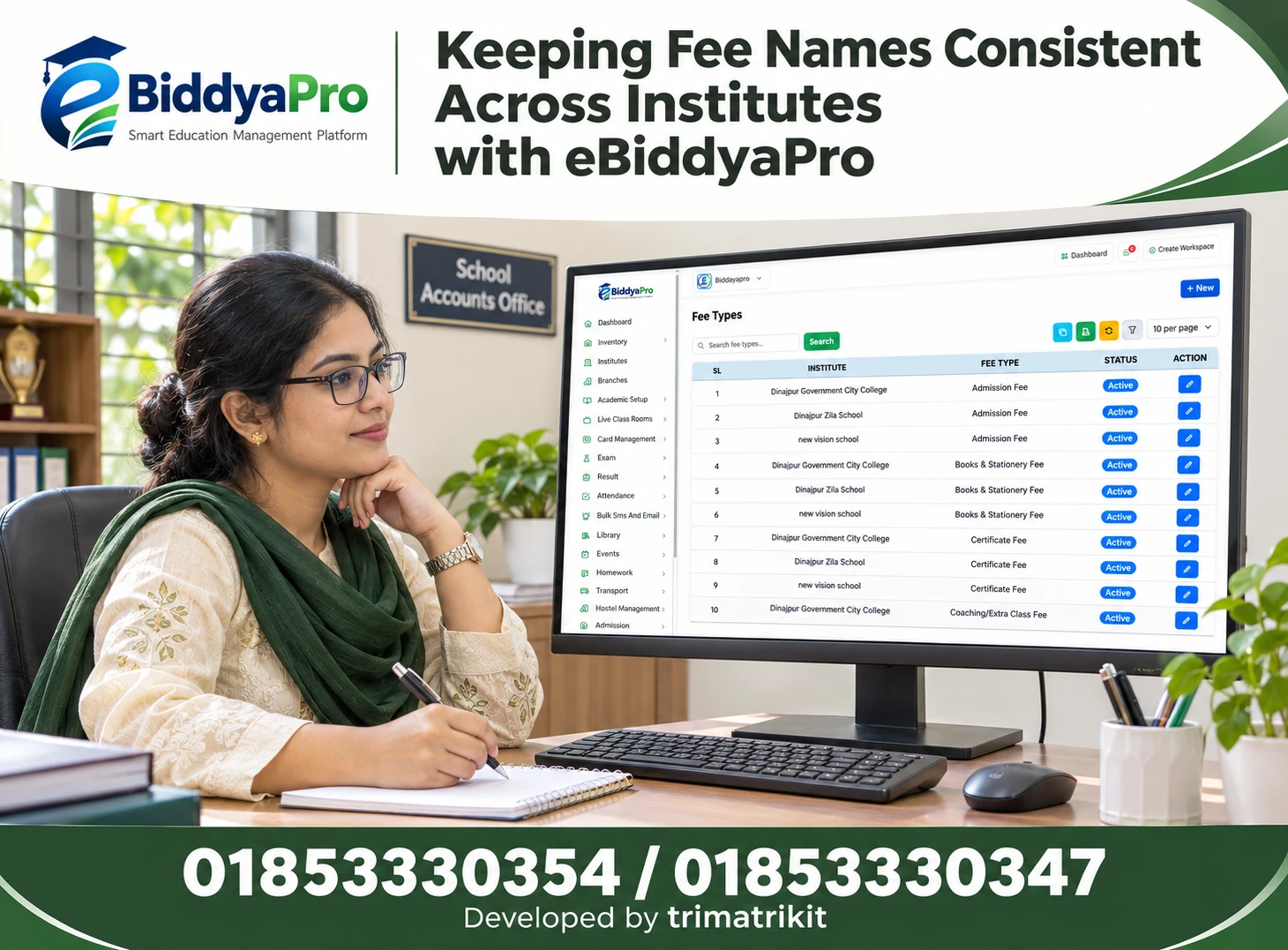
The supplied Fee Types screen identifies categories at institution level. It does not, by itself, establish the complete student billing and collection process.
Ask accounts staff to test realistic examples, including a partial payment and a correction where relevant. Review the resulting receipt and balance.
Also distinguish recording a payment from collecting money through an online payment service. Any payment gateway or banking connection requires separate confirmation.
Guardian Communication Depends on Accurate Relationships
An institution can communicate more reliably when guardian details are current and correctly linked to students.
The supplied Parents Manage interface displays associated children and contact-related information. The complete relationship and access process should be demonstrated.
A shared telephone number is not sufficient evidence that two students belong to the same family. Staff should verify links before granting access or distributing personal information.
Messaging functions also require careful evaluation. A stored contact does not prove that an alert is enabled, delivered, or read.
A dependable EMS should support the communication process the school needs, while staff remain responsible for appropriate recipient selection and follow-up.
Reports Help Leaders Ask Better Questions
Reports can help administrators review information beyond individual records.
A school leader may need to understand enrollment by class, attendance over a period, or outstanding balances. These reports serve different purposes and should define their scope.
UNESCO highlights the role of education information systems in giving decision-makers and practitioners access to relevant information. The practical lesson is that data should help people act on institutional needs, not merely populate dashboards.
During evaluation, trace a summary figure back to sample records. Confirm the session, branch, date range, and unit being counted before relying on the result.
Multiple Branches Need Consistent Administration
An institution with several locations needs a clear relationship between local responsibilities and central oversight.
Consistent institute, branch, class, and subject names can make reports easier to interpret. However, branch fields alone do not establish effective access restrictions or correct consolidated reporting.
Test separate local and central user accounts. Inspect searches, reports, and exports to see whether each account receives the intended information.
Also demonstrate a fictional student transfer. The institution should understand the effect on current assignments and historical records.
A suitable EMS helps organize these relationships only when the implementation reflects the actual operating structure.
Supporting Services Should Be Evaluated Separately
Some schools need hostel, library, inventory, or transport administration.
The supplied eBiddyaPro screens show relevant supporting areas, but a visible directory should not be mistaken for a complete operational system.
For example, recording a hostel supervisor does not establish student room allocation. Maintaining driver information does not prove vehicle tracking. A book category list does not establish the complete issue-and-return process.
Demonstrate each required service from beginning to end. Schools without those requirements may choose to keep them outside the initial implementation.
The importance of an EMS comes from relevant functionality, not the largest possible menu.
Data Protection and Permissions Build Trust
School records can contain personal information about learners, guardians, and employees.
Access should match institutional responsibilities. A teacher may need assigned classes, while accounts staff need appropriate financial records. Broad access should not be granted simply because it is convenient.
Test the available permissions with realistic roles. Examine exports and downloads in addition to ordinary screens.
Also ask how access is removed when responsibilities change. Clarify backup, restoration, and data export arrangements.
An institution should understand what it can recover after an accidental change and what information it can retrieve if the service ends. These questions are part of responsible software selection.
Implementation Requires People and Preparation
A modern school does not become well organized simply by purchasing software.
Existing records may contain duplicates, outdated contacts, and inconsistent class names. Importing those problems without review can preserve them in a new system.
Assign responsibility for preparing and validating each information area. Begin with a small sample and inspect individual records after migration.
Training should include ordinary tasks and exceptions. Users need to know how to investigate an incomplete record, request a correction, and identify the appropriate person for approval.
Staff participation during evaluation helps build a process that is practical after implementation.
Cost, Connectivity, and Long-Term Use
Schools should assess total operating cost rather than subscription price alone.
Configuration, migration, training, integrations, recurring charges, and support conditions may affect the overall commitment. Obtain a written proposal identifying included functions and additional work.
Connectivity should be tested under realistic conditions. Cloud access does not establish offline operation. Where interruption is possible, define an approved fallback and later reconciliation process.
Long-term usability also matters. Ask how a new academic session is prepared, how staff changes are handled, and what assistance is available when requirements change.
A sustainable EMS should fit the institution’s resources as well as its immediate ambitions.
Measure Benefits Through a Pilot
A controlled pilot can establish whether the proposed setup improves the school’s work.
Use fictional or appropriately controlled records to test admission, academic assignment, attendance, fees, and a sample examination. Include representative corrections.
Measure comparable tasks before and after the pilot. Consider search time, preparation effort, incomplete records, and correction frequency.
Do not assume a guaranteed percentage improvement or a direct increase in learning outcomes. Administrative improvements can create better working conditions, but educational results depend on many factors.
A successful pilot should produce understandable evidence of fit and identify remaining limitations before wider rollout.
Frequently Asked Questions
1. Why is an Education Management System important?
It can help schools organize information and use it for academic and administrative work. Its value depends on accurate records, suitable workflows, clear responsibilities, and consistent use.
2. Is an EMS only for large schools?
No. Smaller institutions may also have repeated administrative tasks. The relevant question is whether the proposed system’s benefits, costs, and maintenance requirements match the school’s needs.
3. Is an EMS the same as an LMS?
Their purposes differ. An EMS usually emphasizes institutional administration, while an LMS focuses on learning delivery and related activities. Product scopes can overlap, so assess actual functions rather than terminology.
4. What is eBiddyaPro?
The supplier presents it as a Smart Education Management Platform. The supplied interfaces show several school administration areas. Confirm the exact modules and configuration in the proposed package.
5. Does eBiddyaPro automatically connect every module?
That should not be assumed. Demonstrate the required relationships using complete examples. A visible menu or separate record does not establish automatic data flow.
6. Why are student identifiers important?
They help distinguish students with similar names and maintain a consistent reference. Internal identity, class roll, and external registration information should remain understandable and appropriately separated.
7. Does creating a profile complete enrollment?
Not necessarily. Admission approval and academic assignment can be separate stages. Verify that the student belongs to the correct session, class, and group before using the record operationally.
8. Can an EMS reduce repeated data entry?
It may reduce unnecessary repetition where information is reused through verified workflows. Measure the actual process. Poorly configured relationships can still require manual correction or repeated work.
9. Does missing attendance mean absence?
No. It may indicate incomplete entry or an incorrect selection. Investigate the relevant records before treating missing information as confirmed absence.
10. Are guardian alerts always included?
No assumption should be made. Confirm channels, triggering conditions, recipient selection, costs, and delivery reporting in the proposed setup.
11. Can teachers manage homework?
The supplied interface includes homework entry controls. Teacher permissions, publication behavior, attachments, and learner access should be demonstrated separately.
12. Does an attachment control support student submissions?
Not necessarily. A teacher uploading a resource and a student submitting work are different capabilities. Request a complete demonstration if submission and evaluation are required.
13. Will timetable conflicts be detected?
That capability is not established by the supplied schedule screen. Test overlapping assignments if automatic warnings are important to your institution.
14. Are examination results automatically reliable?
No. Incorrect rules or marks can produce incorrect results. Use independently reviewed examples and test exceptions before approving the configuration.
15. Is a fee type the same as a charge?
No. A fee type identifies a category. Assigning an amount to a student and recording a payment are separate parts of the financial workflow.
16. Does recording a payment collect money online?
No. Recording and online collection are different functions. Payment gateway or bank integration must be confirmed independently.
17. Can branch access be restricted?
The available permission structure needs testing. Use local and central accounts and inspect screens, searches, and exports. Branch labels alone do not prove restrictions.
18. Does hostel management include every residential task?
Not necessarily. A directory, room allocation, residential attendance, and accommodation charges are different requirements. Demonstrate each relevant workflow.
19. Can schools use Bengali and English together?
Test the required names, subject titles, searches, and printed outputs. Interface language and document language may behave differently. Do not rely only on on-screen appearance.
20. Will the system work offline?
Offline operation must be confirmed. Ask what remains accessible during an interruption and how later updates are reconciled. Maintain an approved fallback where needed.
21. What costs should schools consider?
Include subscription, configuration, migration, integrations, training, support, and future changes. A written scope helps distinguish included services from additional work.
22. What should a school demonstrate before purchase?
Follow a fictional student through admission, academic placement, attendance, fees, and results. Include a correction and appropriate user permissions to test the complete process.
Evaluate an EMS Through the Work Your School Needs to Complete
An Education Management System matters when it helps staff maintain dependable records, coordinate responsibilities, and retrieve useful information.
For schools in Bangladesh, the practical approach is to begin with their actual academic structure and administrative requirements. Evaluate eBiddyaPro through complete examples, verify the outputs, and agree on a clear implementation scope.
For an eBiddyaPro demonstration tailored to your institution, contact 01853330354 / 01853330347
Recent Post