EAS Security
 EAS Gate
 Security Tag
 EAS Accessories
 Gadgets
 Convex Mirror
 Road Barrier
 Burglar Alarm
 Calling System
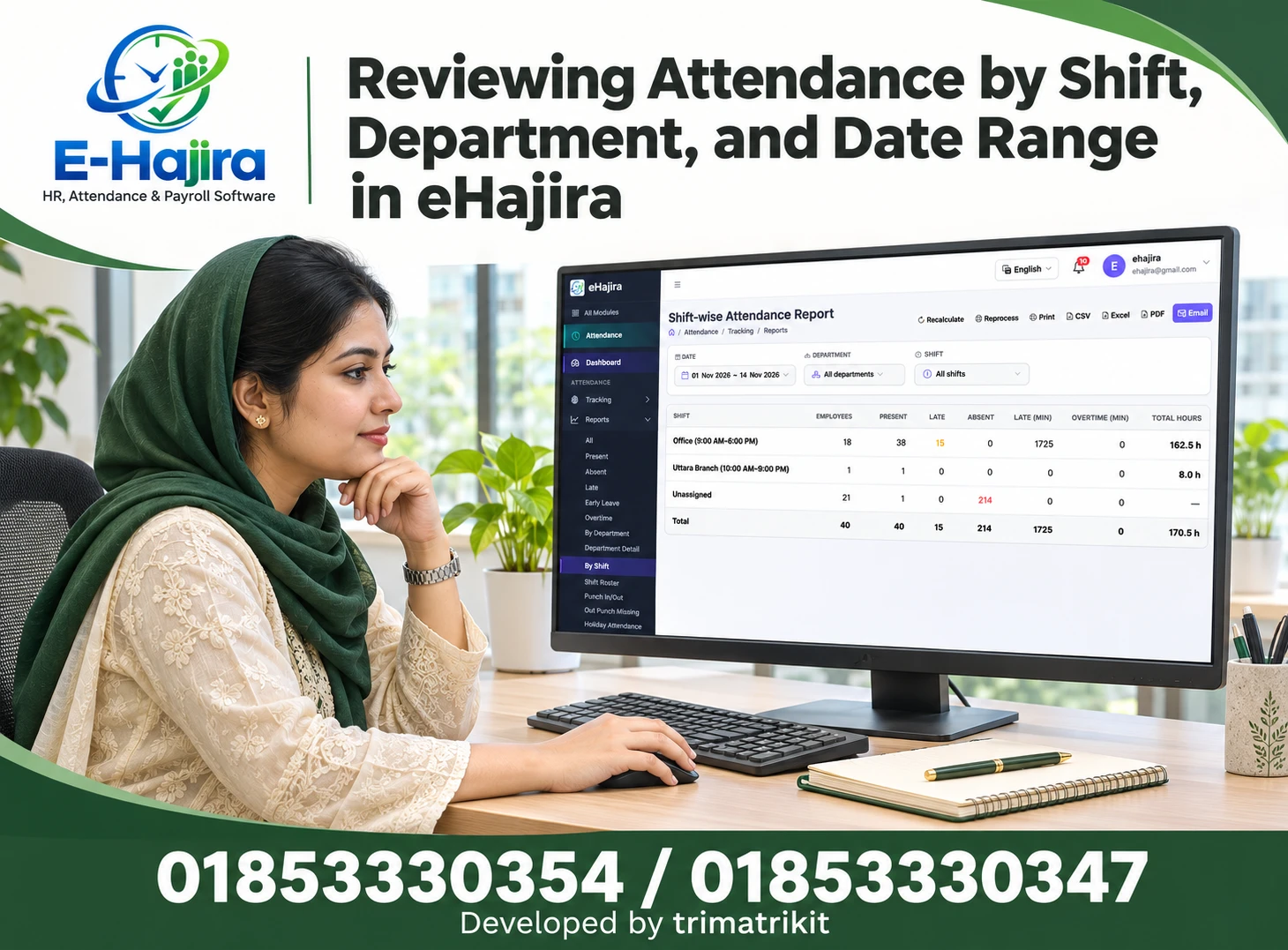
Reviewing Late Attendance by Department and Shift in eHajira
November 14, 2026
Reviewing Late Attendance by Department and Shift in eHajira
An employee checks in at 9:18 AM. Is that eighteen minutes late, an on-time arrival for a different shift, or a record that needs further investigation?
The answer depends on the schedule and attendance rules applicable to that employee on that date. A recorded arrival time becomes meaningful when it is compared with the correct working arrangement.
For organizations in Bangladesh, reviewing lateness can involve employees with different departments, office hours, operational shifts, and approved assignments. A company-wide list may reveal where attention is needed, but department and shift context helps HR interpret the results accurately.
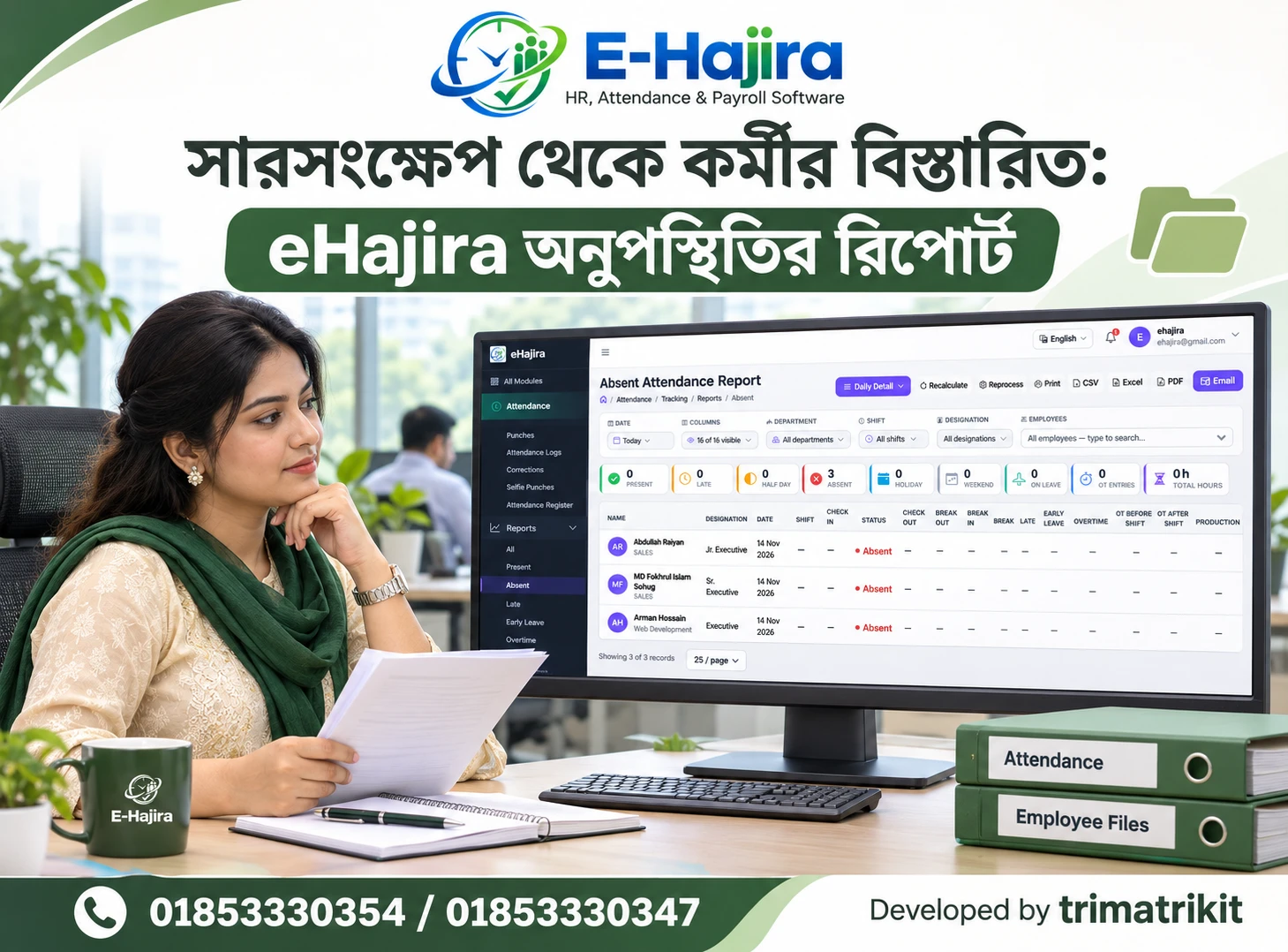
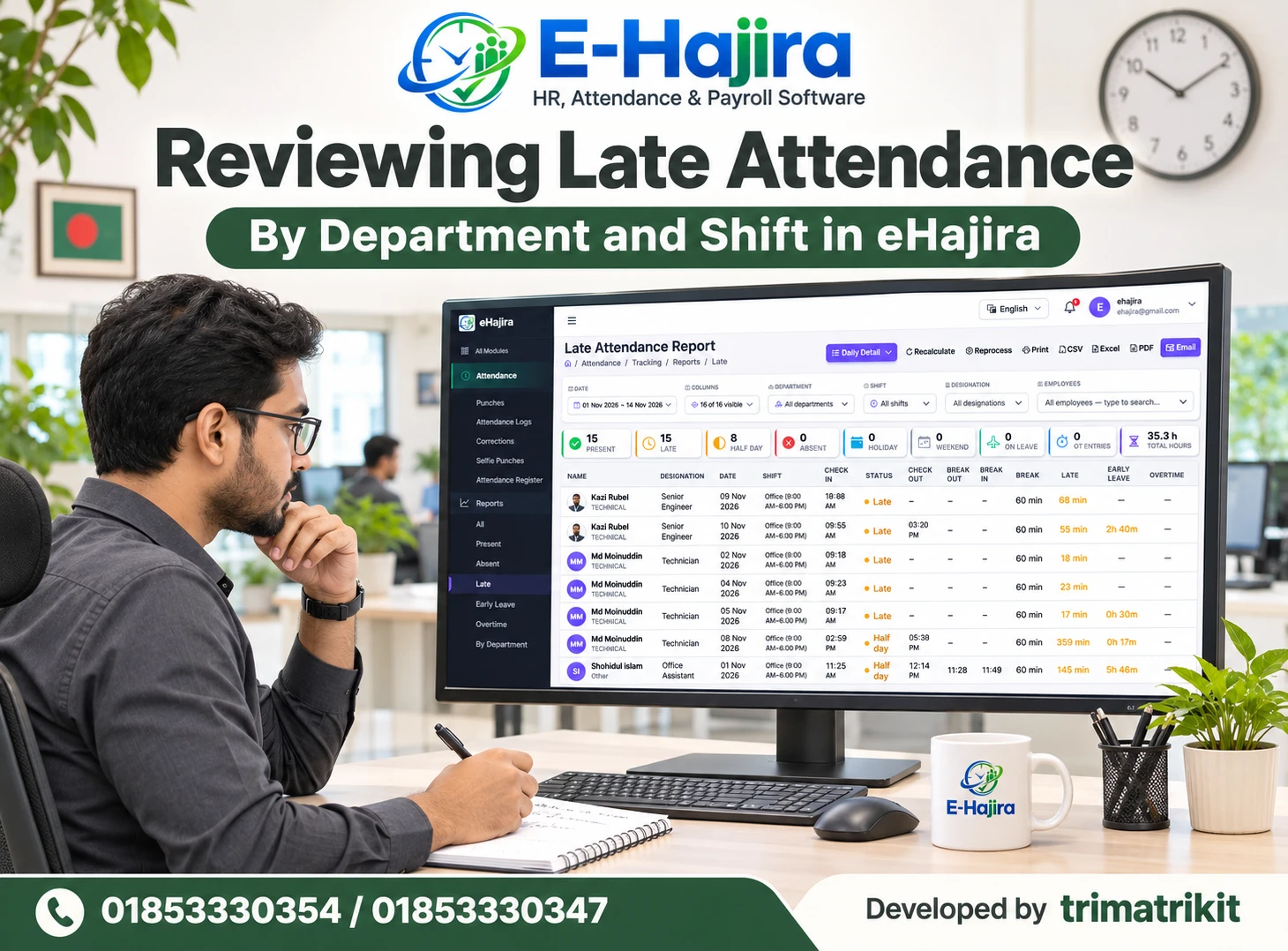
The eHajira Late Attendance Report screenshot shows how these details can be brought together. It includes date, department, shift, designation, and employee filters, followed by summary cards and daily employee records. The rows show check-in times, attendance status, late minutes, early leave, and other time-related information.
This guide explains how to review that information, distinguish repeated daily records from unique employees, and use department and shift filters responsibly. It draws on the supplied interface and published eHajira information while identifying behaviors that need confirmation in an organization’s own configuration.
What the eHajira Late Attendance Report Shows
The supplied page is titled Late Attendance Report, with Daily Detail selected. The date range runs from 1 November 2026 to 14 November 2026.
The filter area includes Columns, Department, Shift, Designation, and Employees. These controls provide context for the records being reviewed.
Below them, the summary displays 15 Present, 15 Late, 8 Half Day, and 35.3 h Total Hours, alongside other categories. The table contains employee names, designations, dates, shifts, check-in, status, check-out, break information, late time, early leave, and overtime-related fields.
Published eHajira supplier information describes the Late Report as a way to review employees arriving after their scheduled shift time. This supports treating the relevant shift as an essential part of lateness interpretation.
However, the screenshot does not reveal every threshold, formula, or counting rule. Those details should be confirmed before the report is used for consequential decisions.
Why Department and Shift Need Separate Attention
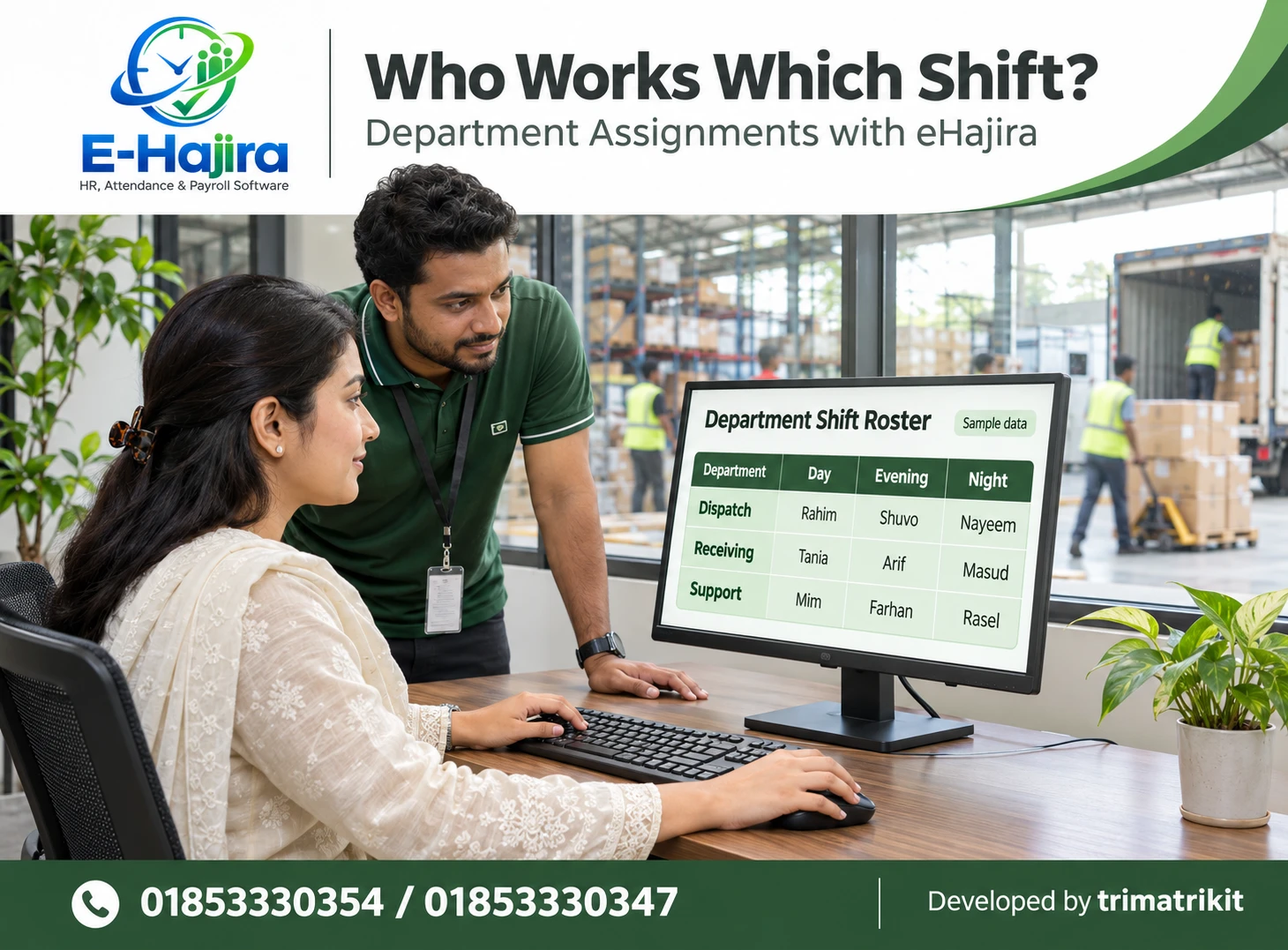
A department identifies an organizational group. A shift provides the time-based context for attendance.
These are related but different dimensions. Two employees in the same department may work different shifts. Employees from several departments may share the same office schedule.
For example, a technical department may include office-based staff and employees assigned to operational coverage. Reviewing everyone against one assumed start time could misrepresent their attendance.
Department filtering helps direct a review to the appropriate supervisor. Shift filtering helps compare records against a relevant schedule.
Using both thoughtfully makes the report more useful. It also prevents a common mistake: assuming that organizational membership automatically establishes the employee’s expected arrival time.
Why This Matters in the Bangladesh Market
Bangladeshi businesses operate across a range of working arrangements. Corporate offices, factories, retail operations, educational institutions, and service organizations may have different attendance needs.
A head office may follow a regular daytime schedule, while another team works rotating shifts. Employees making approved customer visits may have a different attendance collection process.
These differences matter when interpreting a Late label. HR needs to establish the relevant facts rather than treating every record as an identical punctuality problem.
The same principle applies to operational disruptions. If employees report a shared issue, the explanation should be verified and handled through the organization’s approved process.
An attendance report provides structured evidence for that discussion. It does not independently establish the reason for lateness or determine the appropriate management response.
Start with a Defined Review Purpose
Before changing filters, decide what question the report should answer.
A department manager may need to review repeated late arrivals within one team. Payroll staff may need verified exceptions for a completed period. HR may be investigating a specific employee’s disputed check-in.
These tasks require different scopes. A broad report can help identify patterns, while an individual review needs the relevant dates and supporting records.
Defining the purpose also helps determine which information should be shared. A supervisor reviewing one team may not need a file containing the whole organization.
A useful report is not simply a complete table. It is information selected and interpreted for a clear administrative task.
Confirm the Date Range and Reporting Context
The screenshot demonstrates a date range rather than a single day. This is important because one employee can appear on several dates.
Confirm the beginning and end of the selected period before interpreting totals. Reports covering different numbers of working days should not be compared without accounting for that difference.
Also consider whether the period includes an ongoing day. Records may need another review when relevant shifts have finished or outstanding attendance information has been resolved.
When saving an output, identify the actual dates instead of relying on a relative label.
If the organization uses a payroll cut-off that differs from a calendar month, select the corresponding reporting period through the options supported by the application.
Read Daily Records as Daily Records
The same employee appears more than once in the supplied table. These rows show different dates.
Repeated names therefore do not automatically indicate duplicate data. A Daily Detail report can legitimately contain several records for one employee across a selected period.
This distinction affects interpretation of the summary. Fifteen late records should not automatically be described as fifteen different employees arriving late.
Before reporting a unique employee count, confirm how the relevant measure is calculated. If an authorized exported file is used for further analysis, distinguish the employee identifier from the daily attendance record.
Managers need to know whether they are discussing the number of affected people, the number of late days, or the total recorded late minutes. These answer different questions.
Use the Department Filter to Establish Responsibility
The Department filter can focus attention on the team whose attendance is being reviewed.
After selecting a department, confirm that the resulting employees match the intended population. Unexpected names may require checking staff records or the organization’s reporting rules.
For historical periods, consider whether employees transferred between departments. The screenshot does not establish whether the report uses current department membership or the assignment applicable on each attendance date.
This behavior matters when comparing managers or teams over time. A recent transfer should not be interpreted without understanding how the historical record is presented.
Department filtering is most useful when the selected scope and the responsible reviewer are both clear.
Use the Shift Filter to Improve Comparability
The Shift filter helps narrow the report to records associated with a selected schedule.
This can make a review more meaningful than comparing employees who start at different times. However, a common shift label does not remove the need to confirm its applicable rules.
Review the scheduled start and end times, relevant break arrangements, and any attendance thresholds used in the organization’s setup.
If a shift definition changed during the selected period, determine how that change affects historical reports. The current schedule may not explain earlier records.
Do not assume that changing a shift now automatically corrects previous results. Confirm the supported process before modifying settings or running additional actions.
Designation Filters Can Narrow the Population Further
Designation represents a position or job title. It should not be confused with a department or shift.
Combining a designation filter with department and shift selections can produce a much smaller population. If an expected employee disappears, review the combined filters before concluding that there was no late record.
For example, selecting one technical designation could exclude other employees in the same department who have different positions.
Use the designation filter when it serves the review purpose. Leaving an unnecessary selection active can lead to an incomplete report.
When sharing the result, identify the scope clearly enough that another reader can understand which employees were included.
Understand Late Minutes Through the Assigned Start Time
The screenshot contains a straightforward visible example: a 9:00 AM shift start, a 10:08 AM check-in, and 68 min in the Late column.
Another visible record shows a 9:55 AM check-in against a 9:00 AM start, with 55 min displayed as late.
These examples show that the report presents a quantified difference for those records. They do not prove the complete calculation rule for every shift.
Grace periods, rounding, exceptions, and other settings are not demonstrated. Avoid extending one visible example into a universal formula.
When a late value is disputed, review the applicable shift and recorded event first, then confirm any configured rules that affect the result.
Late Duration and Attendance Status Are Different
The supplied Late Attendance Report includes rows marked Late and rows marked Half day. This is an important feature of the visible example.
It shows that a record can appear in the late report while its displayed status expresses another attendance classification.
A visible Half day row also has a substantial late duration. The report therefore should not be read as a table in which every row must carry the same status label.
The underlying inclusion rule and status precedence are not explained by the screenshot. Confirm them before interpreting the relationship between Late and Half Day totals.
Keeping these concepts separate helps HR explain why a late duration and an attendance status can describe different aspects of the same day.
Do Not Add Summary Categories Without Definitions
The summary displays Present, Late, and Half Day values together. These categories should not automatically be added to produce a workforce total.
They may overlap or represent different measures within the report. The screenshot does not establish their complete counting logic.
Likewise, Total Hours should not be treated as total late hours. Its label and relationship to the other time fields need confirmation.
If management asks for a punctuality percentage, define the denominator carefully. A late-only report does not necessarily provide the complete population of scheduled attendance opportunities.
Clear definitions prevent confident-looking calculations that answer a different question from the one the organization intended.
Review Missing Check-Out Information Separately
Several visible rows have a check-in and late duration but no check-out time.
A late arrival can therefore be recorded while the rest of the working day remains incomplete in the displayed information.
Do not interpret the missing check-out as proof that the employee immediately left work. Equally, do not invent a departure time to complete the row.
Review the underlying attendance information and use the approved correction process where necessary.
This distinction is especially important before payroll preparation. A record may need both a punctuality review and resolution of incomplete time information.
Read Early Leave Alongside Late Arrival
A person can arrive late and also leave before the scheduled end. The supplied report contains early leave values beside some late records.
These are separate time exceptions. They should be reviewed independently before drawing a conclusion about the day.
An approved arrangement may explain one exception, while another value may require correction. The presence of both does not establish the employee’s intent or the final payroll outcome.
Confirm the relevant schedule, recorded times, and authorization information.
When communicating with the employee, describe the specific date and values under review. A precise discussion is more useful than a general statement that the employee had a “bad attendance day.”
Treat Break and Production Fields Carefully
The table includes Break Out, Break In, Break, and Production fields.
A displayed break duration should not automatically be interpreted as a recorded break interval or assumed to have been subtracted from every other time value.
Similarly, Production is expressed in hours in the supplied example. That does not establish an output-based productivity measure or a salary quantity.
Confirm each field’s definition and calculation relationship before using it in analysis.
The strongest review stays close to established facts: which times are recorded, which schedule applies, and which calculated fields have documented meanings in the organization’s configuration.
Investigate Unexpected Results Through Supporting Records
A surprising late value is a reason to investigate, not a reason to change the employee’s record immediately.
Compare the report with the relevant punch information, daily attendance log, and shift assignment. Confirm that the event belongs to the correct person and date.
If the issue affects several employees, consider whether a shared timing or data problem needs review. If it affects one employee, focus on that individual record.
Possible explanations should remain possibilities until evidence supports them.
For a support request, provide the employee reference, date, selected shift, displayed time, and the specific result that appears inconsistent. This makes the issue easier to reproduce and explain.
Use the Why? Link for Available Explanation
A Why? link appears beside the visible rows.
Use it when additional explanation is needed, while recognizing that the screenshot does not show its contents.
It may provide relevant detail, but this guide cannot promise a complete formula, approval history, or every underlying event.
Compare whatever explanation is available with the report and supporting information. If the question remains unresolved, ask for clarification rather than treating an unexplained value as final.
A useful administrative record includes both the result and enough context to explain why the organization accepted or corrected it.
Understand Recalculate and Reprocess Before Use
Both Recalculate and Reprocess are visible controls.
Their different names should not be treated as interchangeable instructions. The screenshot does not establish their scope, permissions, or effects.
Before using either action, confirm what it does and which records it affects. Determine whether the action is appropriate for the suspected problem.
Repeatedly running both controls without identifying the issue can make the review harder to explain.
After an authorized action, revisit the same filters and compare the relevant records. Confirm that the result now matches the verified information rather than assuming that the action itself resolved the issue.
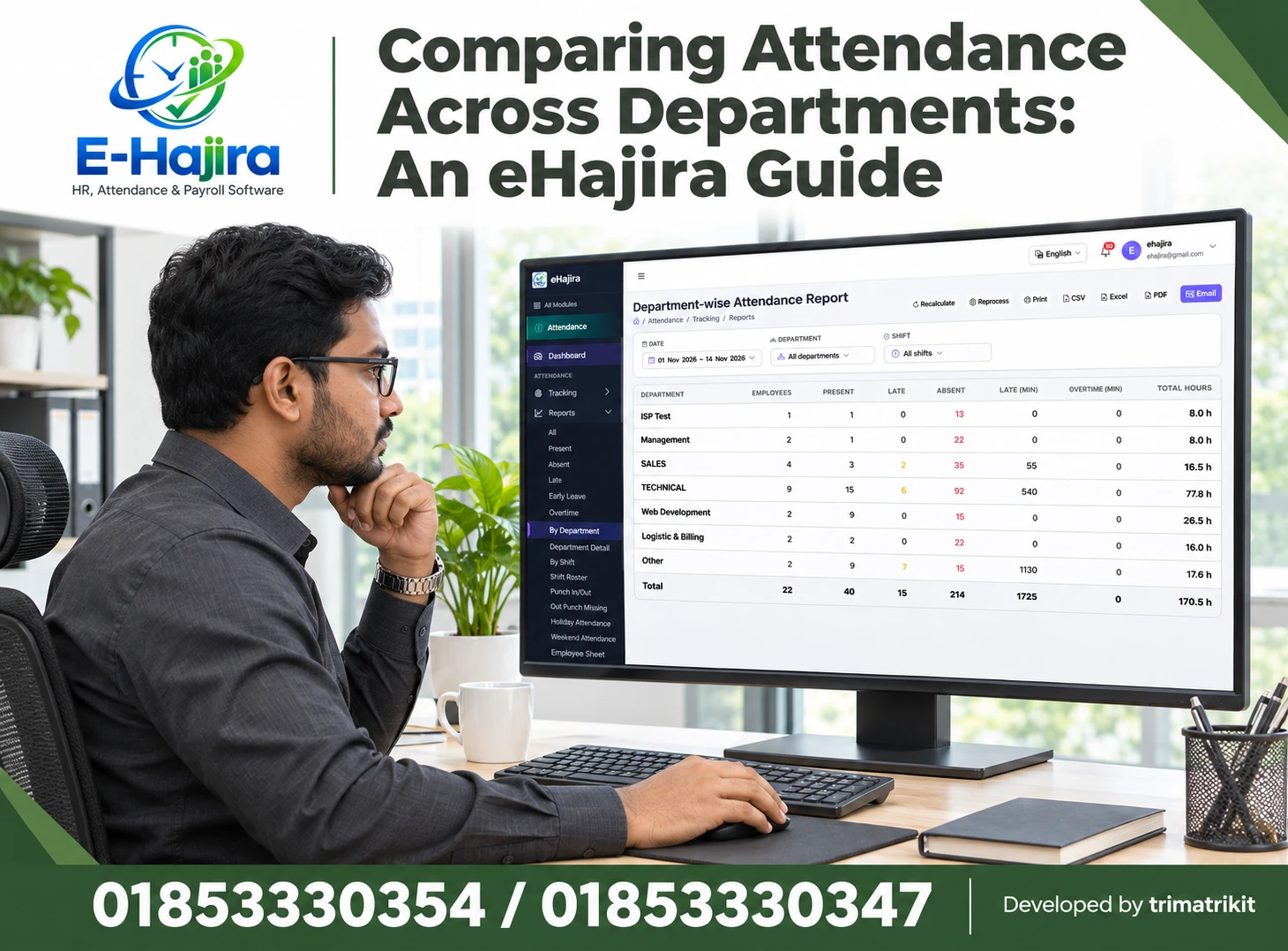
Compare Departments Fairly
A larger department may produce more late records simply because it has more employees or scheduled days.
If the organization wants to compare departments, use a clearly defined method and a suitable population. Distinguish total late events, affected employees, and duration.
For example, twenty late records across a large team and five across a small team cannot be interpreted fairly from those counts alone.
This is a general analytical recommendation, not a claim that the supplied report automatically calculates normalized comparisons.
Use the broader attendance information needed for the question and explain the method when presenting the result. Avoid ranking departments solely from a filtered late list.
Review Exports, Email, and Access
Print, CSV, Excel, PDF, and Email controls are visible. Before producing or sharing an output, verify the reporting period, filters, included columns, and intended recipient.
Check a sample file to understand whether all relevant records are included. The relationship between visible columns and exported columns should be confirmed.
Employee attendance information should be shared according to responsibility. OWASP’s least-privilege guidance supports giving users only the access needed for their work; this is a general security principle rather than proof of a specific eHajira permission setting.
A department supervisor may need their team’s records without needing a company-wide file. Keep that distinction clear in the reporting process.
Keep Lateness Review Separate from Automatic Payroll Conclusions
A verified late duration can support payroll preparation, but it does not independently establish a deduction.
Approved working arrangements, resolved corrections, and the applicable financial process need separate consideration.
Do not assume that a late arrival is offset by a later departure unless the approved arrangement and configured calculation support that treatment.
Similarly, a Half day label should not be converted into a financial outcome without understanding its meaning and the relevant process.
For organizations in Bangladesh, a clear handover between HR and payroll helps: HR verifies attendance facts and exceptions, while the authorized payroll process determines their financial treatment.
Frequently Asked Questions
1. What is the eHajira Late Attendance Report?
It is a report for reviewing late-related attendance records. The supplied interface includes employee details, dates, shifts, check-in times, late durations, and other daily attendance information.
2. Can I review lateness by department?
Yes, a Department filter is visible. Confirm the resulting employee population and identify the scope when sharing the report. A department-specific result is not a company-wide total.
3. Can I filter by shift?
Yes, the screenshot includes a Shift filter. Use it to focus the review on the relevant schedule, while also confirming the rules applicable to the selected dates.
4. Does fifteen late records mean fifteen employees?
Not necessarily. The same employee can appear on different dates in Daily Detail. Confirm whether a total counts daily records, unique employees, or another measure.
5. Why does one employee appear several times?
The report covers a date range and displays daily details. Different dates can legitimately produce multiple rows for one person. Repeated names alone do not prove duplicate data.
6. Why are Half day records in the late report?
The supplied screenshot shows that combination. It indicates that report inclusion and displayed status may describe different aspects of a record. Confirm the exact rules in your setup.
7. Can Present and Late totals overlap?
The screenshot does not establish their complete counting relationship. Do not add summary categories into a headcount without definitions. Ask which measure each card represents.
8. How are late minutes calculated?
Visible examples align arrival time with the displayed shift start. However, grace periods, rounding, and exceptions are not shown. Confirm the applicable formula before generalizing.
9. Does eHajira allow a grace period?
That setting is not demonstrated in the supplied screen. Check the relevant attendance configuration or product guidance rather than assuming a particular allowance.
10. Is a 9:18 AM arrival always late?
No. Its meaning depends on the employee’s applicable schedule and rules. Confirm the correct shift for that date before interpreting the recorded time.
11. What if the employee’s shift changed?
Review the assignment that applied during the reporting period. Confirm how historical shifts are handled. A current shift definition may not explain an earlier record.
12. Is designation the same as department?
No. Designation identifies a position, while department identifies an organizational group. Combining them can narrow the population, so check both when records appear missing.
13. Does missing check-out mean the employee did not work?
The blank field alone does not establish that. Review the relevant records and resolve incomplete time information through the approved process before making a conclusion.
14. Can late arrival and early leave occur together?
Yes, both values appear in some visible records. Review each exception separately and compare it with the schedule and any approved arrangement.
15. Is Total Hours the total late duration?
That meaning is not established by the screenshot. Confirm the definition before using it. A general hours total and summed late minutes are different measures.
16. Does Production measure work output?
The supplied column uses hours. It is not demonstrated as a productivity score. Confirm its calculation before using it for performance or payroll analysis.
17. What does Why? show?
The link is visible, but its contents are not. Open the available explanation for the relevant record and compare it with supporting information. Do not assume it contains every detail.
18. Should I run Recalculate or Reprocess?
Understand the purpose, scope, and consequences of each action first. Identify the issue and follow the supported procedure. The screenshot does not demonstrate their full behavior.
19. Can I export the report?
CSV, Excel, and PDF controls are visible. Inspect a sample to confirm record coverage, columns, and formatting before relying on the file or distributing it.
20. Can I email the report?
An Email control is present. Verify the recipient, content, and attachment behavior before sending. The complete workflow is not shown in the screenshot.
21. Does lateness automatically justify a salary deduction?
A report value alone does not establish the financial outcome. Verified attendance, approved arrangements, and the applicable payroll process must be considered.
22. What makes a department comparison reliable?
Use consistent periods, relevant schedules, and a defined employee population. Distinguish events, people, and duration. Raw late counts alone may not support a fair comparison.
Turn Late Attendance Data into a Clear Review
Department and shift context make eHajira’s late attendance information more meaningful. The goal is to understand which employees and dates need attention, whether the correct schedule was applied, and which exceptions remain unresolved.
A consistent review process combines accurate filters, supporting records, clear calculation definitions, and verified outputs. This helps HR explain results and gives management a stronger basis for decisions.
For guidance on reviewing attendance by department and shift with eHajira, contact 01853330354 or 01853330347.
Recent Post