EAS Security
 EAS Gate
 Security Tag
 EAS Accessories
 Gadgets
 Convex Mirror
 Road Barrier
 Burglar Alarm
 Calling System
What Is Payroll Management and Why Is It Important for Businesses?
November 15, 2026

What Is Payroll Management and Why Is It Important for Businesses?
Payroll management is the process of organizing employee pay from the information used in a calculation to the records confirming what was approved and paid. It involves more than multiplying a salary figure or preparing a bank transfer. Employee details, salary components, attendance, approved leave, adjustments, deductions, and payment records can all influence the process.
For businesses in Bangladesh, payroll connects HR administration with financial responsibility. Employees expect understandable salary information and dependable payment. Management needs reliable payroll costs, while HR and accounts teams need records they can explain and reconcile.
When these activities depend on disconnected spreadsheets and informal messages, errors become harder to identify. A salary revision may be entered in one file but missed in another. An approved leave correction may arrive after payroll preparation. A payment failure may remain unnoticed because the payroll sheet already shows an approved amount.
This guide explains how payroll management works, why it matters, and what businesses should evaluate when considering eHajira for payroll administration.
Understanding Payroll Management
Payroll management covers the controlled preparation, review, approval, payment coordination, and recording of employee remuneration.
The process starts with dependable employee information and an approved basis of pay. It continues through period-specific inputs, calculations, review, and communication. It should also account for corrections and reconciliation after payment.
Payroll is therefore both a calculation process and an administrative responsibility. A mathematically correct result can still be wrong if it uses an outdated salary or belongs to the wrong employee.
A useful payroll process allows an authorized reviewer to answer several questions clearly: who is being paid, which period is covered, what components are included, what adjustments apply, and how the final amount was determined.
Payroll Management in the Bangladesh Business Context
Different businesses have different payroll requirements. A professional services office may mainly process monthly salaries. A retailer may have employees across several outlets. A business operating shifts may need additional attendance review before payroll preparation.
These examples illustrate operational differences; they are not findings from a survey of Bangladeshi employers.
Organizations should identify their own requirements before choosing software. Employee categories, salary arrangements, payment periods, attendance policies, and approval responsibilities all affect the proposed setup.
Local suitability also includes practical matters such as Bengali and English employee names, amounts in taka, usable reports, and accessible implementation support. These details should be tested using the business’s own examples rather than assumed from a product label.
Basic Salary, Gross Pay, and Net Pay
Basic salary, gross pay, and net pay describe different amounts.
Basic salary is a defined component of an employee’s remuneration arrangement. Gross pay generally describes earnings before applicable deductions. Net pay is the amount remaining after the relevant deductions and adjustments included in the calculation.
ILOSTAT distinguishes gross remuneration from amounts after employer deductions. This supports the importance of keeping the concepts separate, although the classification of individual components must follow the applicable payroll and reporting framework.
For a simple arithmetic illustration, gross earnings of BDT 30,000 less BDT 2,000 in applicable, verified deductions would produce net pay of BDT 28,000. This example does not establish that any particular deduction is legally permitted or appropriate.
Why Accurate Employee Information Comes First
Every payroll result belongs to a person. Incorrect identity information can lead to a payment being associated with the wrong profile or a duplicate employee being included.
A dependable employee record should use a clear internal identifier. Names, departments, designations, employment status, and relevant payment information should be maintained through an approved process.
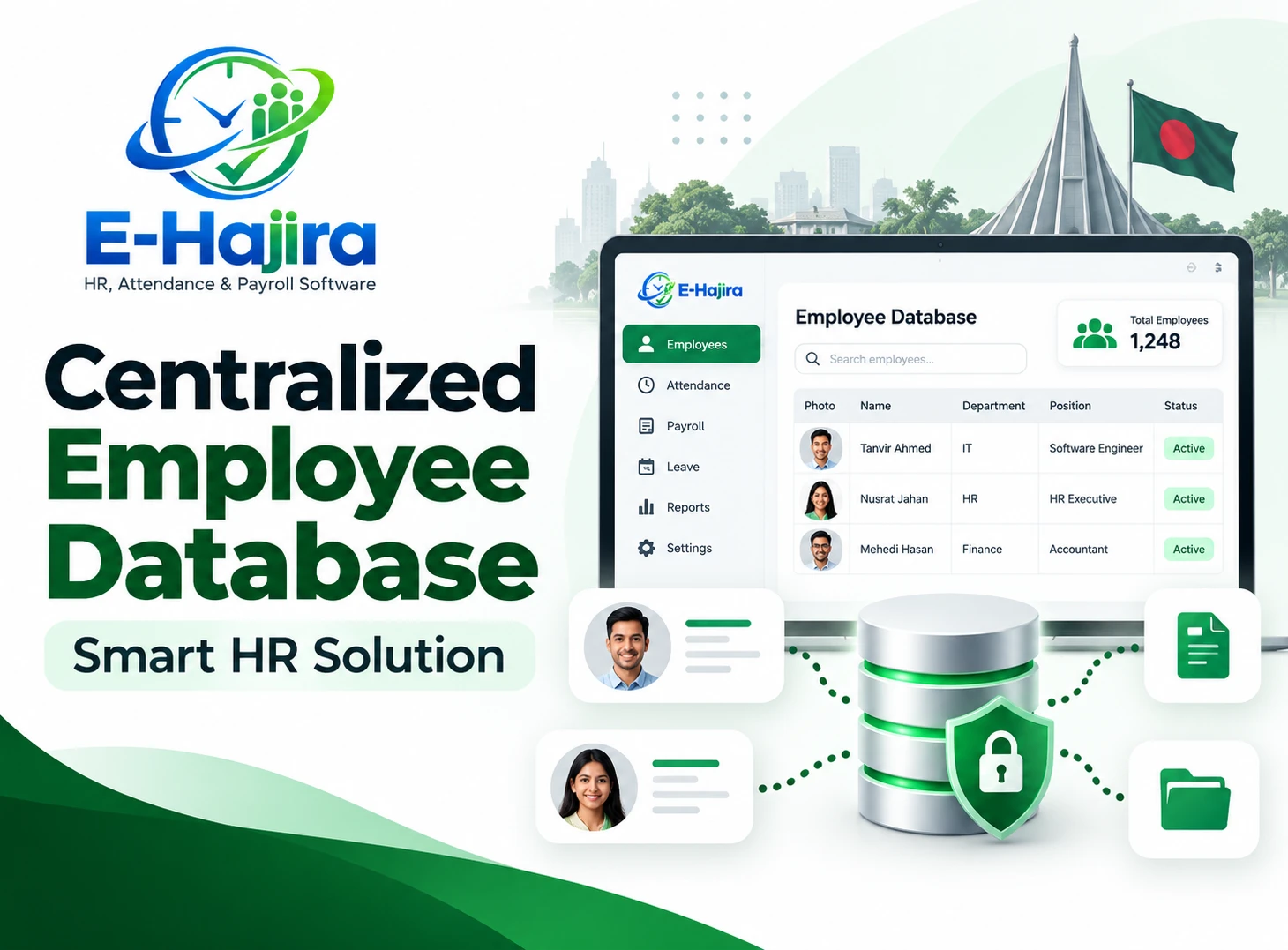
The supplied eHajira Employees interface displays several of these administrative fields. However, a visible employee list does not establish how every field affects payroll.
During evaluation, create fictional employees with similar names and inspect how they appear in payroll preparation. Also test joining, leaving, and status changes. Confirm which records remain eligible for a pay period and how historical information is preserved.
Salary Structures Need Clear Definitions
A salary structure describes the components used to determine remuneration. Depending on the organization, these may include basic salary, allowances, or other approved elements.
The important requirement is clarity. Each component should have a defined meaning, calculation basis, and treatment within the business’s approved framework.
For example, a fixed allowance and an expense reimbursement may serve different purposes. Combining them under an unclear label can make payroll explanation and financial reporting difficult.
When assessing eHajira, ask the supplier to demonstrate the salary structures relevant to your organization. Confirm whether components use fixed values, formulas, or another method, and inspect how changes affect the resulting calculation.
Attendance Provides Inputs, Not Automatic Conclusions
Attendance information can be relevant to payroll, but a status label should not be treated as a complete pay decision.
A missing check-out may reflect a missed scan or delayed data. An absence label may require review against approved leave or another authorized arrangement.
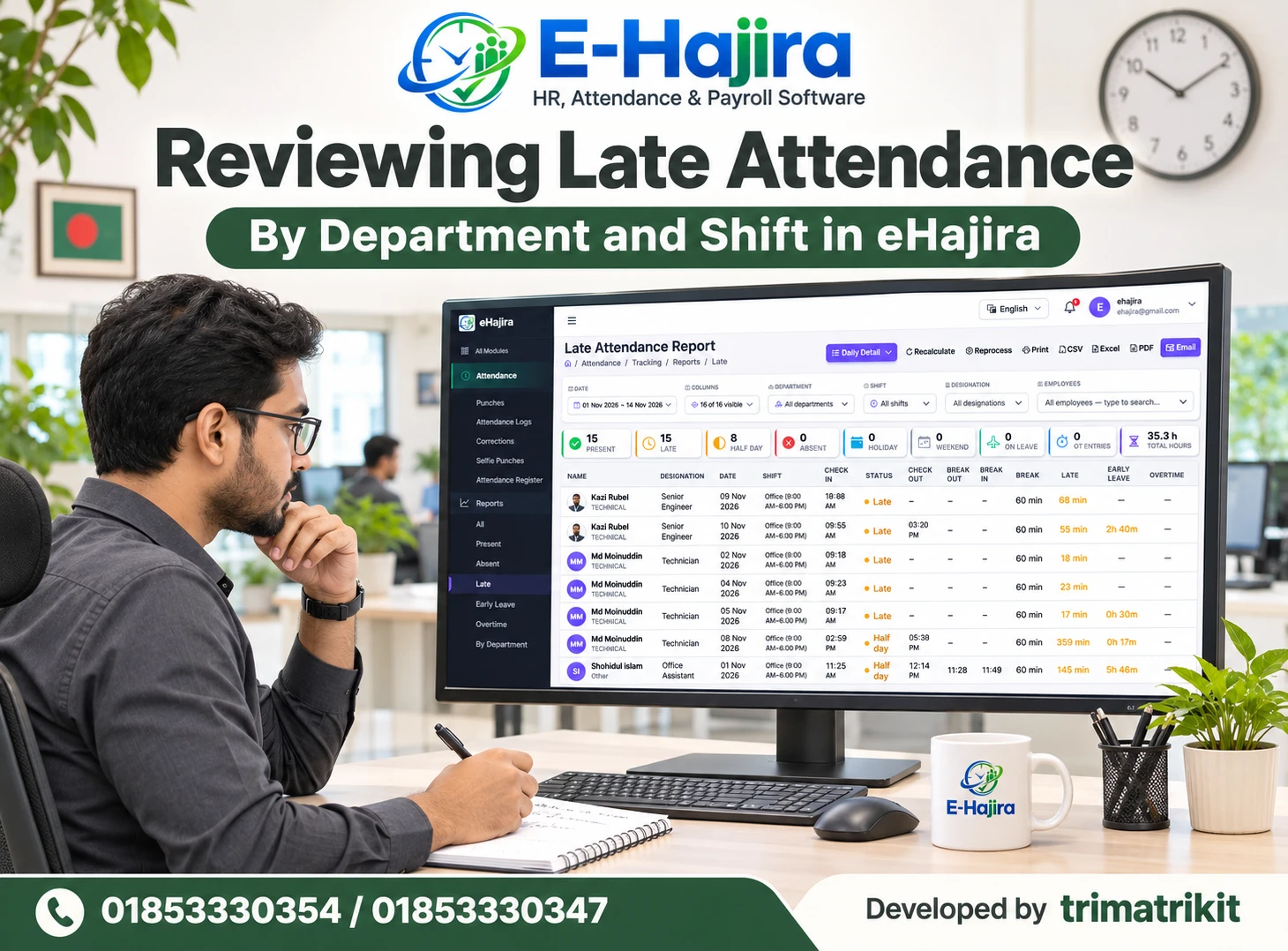
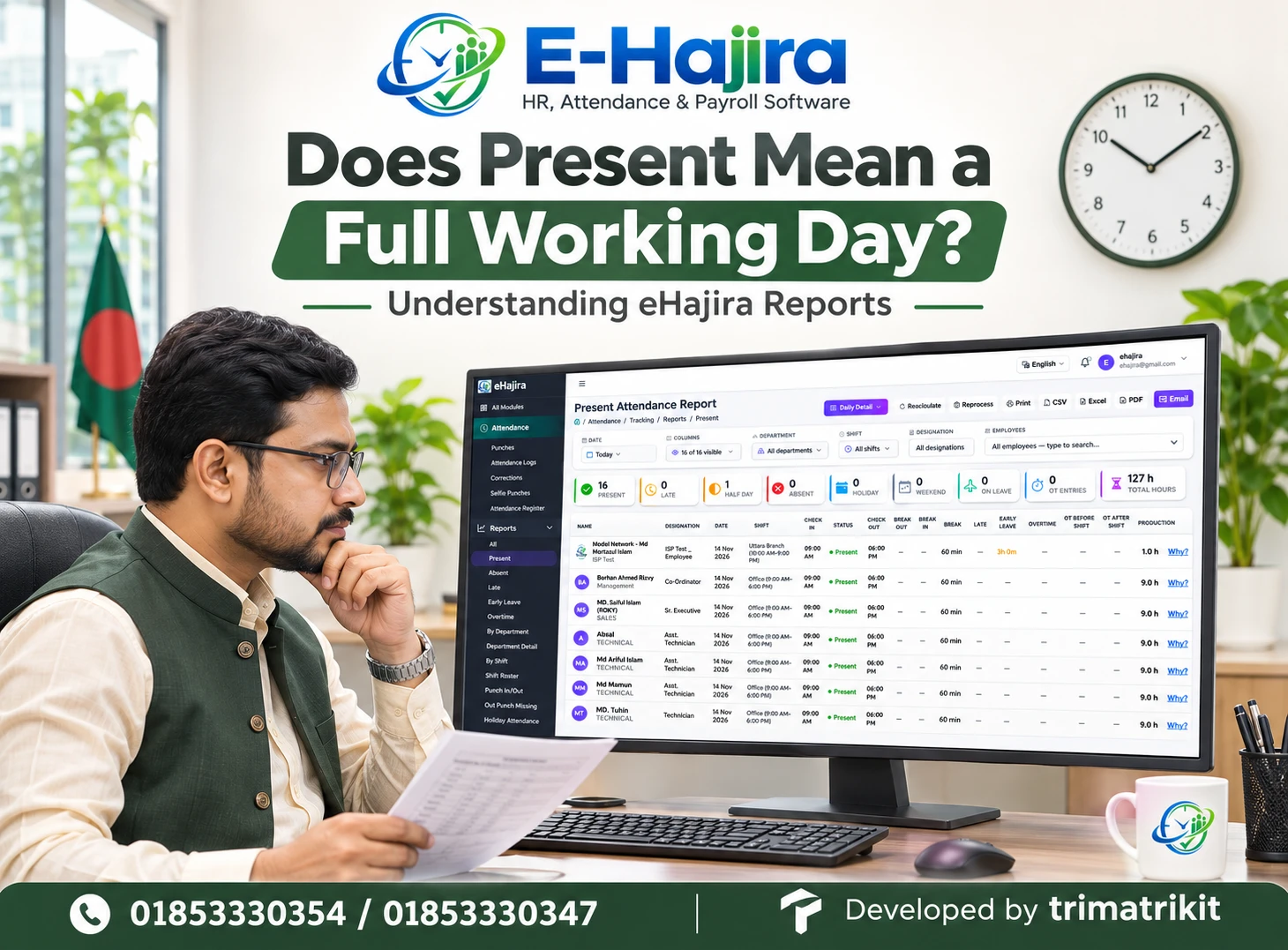
The supplied eHajira interfaces separate Punches, Attendance Logs, and attendance reports. This provides a useful starting point for investigating the evidence behind a daily result.
Businesses should establish which attendance information becomes payroll input and who confirms it. Unresolved data should not silently become an unexplained adjustment. The software’s configured rules and the organization’s authorized process must work together.
Leave Must Be Reviewed Through Its Approval Process
A leave application and an approved leave decision are different events. Their effect on payroll depends on the applicable arrangement and rules.
Payroll preparation should use the correct decision rather than an informal message or an incomplete request. Cancellation and retrospective corrections also need a defined process.
During an eHajira demonstration, follow a fictional leave request through approval and inspect its effect on the relevant period. Then test a cancellation or correction.
The purpose is to establish traceability. A payroll reviewer should understand why the leave-related treatment was applied and which approved record supports it.
Overtime Requires Verified Eligibility and Rules
Working beyond a scheduled time does not, by itself, establish the final amount payable. Eligibility, authorization, applicable rules, and the reliability of the recorded time all matter.
A business evaluating software should distinguish recorded extra time from approved overtime used in payroll.
Ask the supplier to demonstrate the organization’s verified requirements with sample records. Inspect how the relevant time is identified, reviewed, and included in a calculation.
This article does not prescribe an overtime rate or a universal calculation formula for Bangladesh. The applicable legal and employment requirements need current, qualified review before being configured in software.
Adjustments and Deductions Need an Explained Basis
A deduction should never be treated as valid merely because software provides a field for entering it.
Businesses need an appropriate basis, authorization, supporting records, and clear communication for applicable deductions and adjustments.
The ILO’s wages guidance emphasizes transparent calculations showing gross wages, deductions and their purposes, and net wages due. These are useful general principles for payroll administration; they do not replace the specific legal requirements applying to a business in Bangladesh.
In a demonstration, ask how an adjustment is recorded and explained. Confirm whether reviewers can identify its source, applicable period, and approval before payroll is finalized.
Salary Revisions and Arrears Need Effective Dates
An approved salary change may be entered on one date but apply from another. Payroll must distinguish these dates.
Without that distinction, a business may apply the new amount too early, miss an adjustment, or unintentionally alter an earlier payroll result.
Use a fictional salary revision to evaluate eHajira. Ask how the effective period is recorded and whether any resulting arrears are visible and explainable.
Also examine historical outputs. A current salary change should not be assumed to leave earlier calculations unchanged unless that behavior has been demonstrated. The organization needs to know how previous approvals and revised figures are retained.
Payslips Support Employee Understanding
A payslip helps employees understand the calculation associated with their pay. Its usefulness depends on accurate information and clear presentation.
A practical payslip should allow the employee to identify the period and understand relevant earnings, deductions, and the resulting amount.
The supplier’s eHajira information describes payroll processing and payslip generation. This is a published product description, not an independent verification that every institution-specific layout or calculation is supported.
Request an actual sample output during evaluation. Check long names, Bengali text where needed, component labels, and the distinction between earnings and deductions. Confirm who can access or distribute the document.
Payroll Preparation and Salary Payment Are Different
An approved payroll amount is not proof that payment has reached the employee.
A business may prepare payroll in one system and initiate payment through a separate banking process. Payment can fail even when the payroll calculation is correct.
The organization should therefore distinguish calculated, approved, submitted for payment, and confirmed paid information in its overall process. Whether eHajira records those stages must be demonstrated.
If bank files or direct payment connections are required, verify the exact capability and supported format. Do not infer salary disbursement from payslip generation or a general payroll feature description.
Reconciliation Completes the Process
Payroll reconciliation compares related records to identify differences.
Before payment, the business can compare the proposed payroll with approved inputs and expected totals. After payment, it should compare the approved amounts with actual payment results through its authorized financial process.
Unexpected differences deserve explanation. A change in headcount, a revised component, or a one-time adjustment may be legitimate, but the reason should be traceable.
For software evaluation, include a deliberately incorrect sample input and check whether the review process exposes it. A useful system should help staff investigate differences rather than simply produce a final total.
Why Payroll Management Matters for Employees
Salary information affects an employee’s ability to understand and plan personal finances. Unexplained differences can create uncertainty and repeated enquiries.
An organized payroll process makes it easier to respond with the relevant record rather than asking the employee to wait while several files are searched.
Where employee self-service is included, it may help employees access appropriate payroll documents. The exact access and available functions need confirmation in the selected package.
Transparency does not mean every employee should see everyone else’s pay. It means each person can receive an appropriate explanation of their own calculation through a controlled process.
Why Payroll Management Matters for Business Planning
Payroll information supports decisions about recurring employment costs and expected payment requirements.
However, net employee payments are not necessarily the same as the organization’s total employment expense. Employer-side costs and other financial treatments may need separate consideration.
Management reports should therefore define what each total represents. A department report based on current assignments may also differ from one based on historical assignments.
Ask for the reports your business actually needs. Test the period, employee population, organizational grouping, and calculation basis. A visually attractive dashboard is useful only when the underlying meaning is clear.
Bangladesh Tax and Regulatory Requirements
Payroll in Bangladesh must be assessed against the requirements applicable to the employer, employee, and payment period.
NBR publishes the Income Tax Act and subsequent amendments, as well as withholding-related rules. The existence of updated official material is a reason to verify the applicable position rather than reuse an old payroll configuration without review.
This guide does not provide tax thresholds, rates, or statutory payment deadlines.
If your organization needs tax calculations, certificates, returns, or other statutory outputs, obtain current professional guidance and demonstrate the precise software support. A payroll module should not be assumed to include automatic tax filing or every required document.
How eHajira Fits into Payroll Evaluation
eHajira’s published catalogue describes salary structures, allowances, deductions, bonuses, payroll cycles, and payslips using attendance and leave information. These descriptions identify functions to examine in the proposed implementation. They do not guarantee correct results from unverified inputs.
Evaluate the full sequence using fictional employees. Begin with identity and salary information, add the applicable period inputs, review the calculation, and inspect the resulting output.
Then introduce a correction. Observe who can make it, whether approval is required, and what happens to previous results.
A complete example reveals more than a general presentation because it tests the relationship between records and responsibilities.
Permissions and Confidentiality Are Essential
Payroll information should be available only to people with an appropriate responsibility.
An employee may need access to their own payslip, a supervisor may need to approve relevant inputs, and accounts staff may need financial outputs. Those requirements are different.
During evaluation, test separate user accounts. Examine exports and downloaded documents as well as ordinary screens.
Also establish how access is removed when a person changes role or leaves. Shared administrator accounts make it harder to determine responsibility for changes. The proposed configuration should support the organization’s required boundaries, and any limitations should be documented.
Implementation, Cost, and Training
The full cost of payroll software includes more than its subscription.
Configuration, migration, attendance integration, training, support, and future changes can affect the overall commitment. Obtain a written proposal identifying the functions included and the responsibilities of both parties.
Before migration, verify employee records, salary components, and opening information. Historical payroll data should be imported only through a reviewed process.
Training should cover exceptions and corrections, not just routine calculation. Users need to know what to do when an attendance record is incomplete, an adjustment arrives late, or an output does not match the expected result.
Measure Success with a Controlled Pilot
Start with a manageable sample representing the business’s actual payroll arrangements.
Compare software results with independently reviewed expected figures. Include ordinary pay, an applicable adjustment, a salary revision, and another representative exception.
Measure preparation time, correction frequency, and the effort required to explain a result. Avoid claiming a guaranteed percentage improvement without comparable evidence.
Agree on acceptance criteria before production use. A successful pilot should establish understandable calculations, appropriate access, dependable outputs, and a process the team can maintain.
Frequently Asked Questions
1. What is payroll management?
It is the controlled process of preparing, reviewing, approving, coordinating payment, and recording employee remuneration. It includes the supporting information and corrections needed to explain the result.
2. Why is payroll management important?
It helps businesses organize employee pay, maintain understandable records, investigate differences, and coordinate financial responsibilities. Its effectiveness depends on accurate information and a dependable approval process.
3. Is payroll management only salary calculation?
No. Calculation is one part. Employee data, period inputs, review, payslips, payment coordination, reconciliation, and corrections are also relevant to a complete process.
4. How is basic salary different from gross pay?
Basic salary is a defined remuneration component. Gross pay generally includes relevant earnings before deductions. The exact components depend on the applicable arrangement and reporting framework.
5. What is net pay?
Net pay is the resulting amount after applicable deductions and adjustments included in the calculation. Every difference from gross pay should have a clear, verified explanation.
6. Does attendance automatically determine salary?
No. Attendance can provide inputs, but approved leave, schedules, relevant policies, and other requirements may affect treatment. A daily status alone is not a complete payroll decision.
7. Should missing punches create automatic deductions?
A missing punch requires investigation and the applicable verified process. It may indicate incomplete data. Software settings do not, by themselves, establish a lawful deduction.
8. Does extra recorded time always qualify as overtime?
Not necessarily. Eligibility, authorization, applicable rules, and the reliability of time records must be considered. Test how recorded time becomes approved payroll input.
9. What is a payroll period?
It is the defined period covered by a pay calculation. The organization should clearly distinguish that period from input cut-off dates, approval dates, and actual payment dates.
10. What is a payroll cut-off?
It is an operational deadline for including relevant information in a processing cycle. The business should define how late information is handled without disregarding applicable obligations.
11. Can eHajira generate payslips?
Published product information describes payslip generation in relevant offerings. Confirm the selected package, required layout, available fields, and employee access through a demonstration.
12. Does generating a payslip transfer salary?
No. A payslip describes the calculation. Salary disbursement is separate. Any banking integration, payment file, or confirmation process needs specific verification.
13. Can eHajira calculate Bangladesh income tax automatically?
That capability is not established by a general payroll description. Ask for a demonstration based on current verified requirements. Tax calculation and statutory filing are separate capabilities.
14. Why do salary changes need effective dates?
The date a change is entered may differ from the period it applies to. Effective dates help determine the correct treatment and investigate any resulting adjustment.
15. What are salary arrears?
They generally concern amounts relating to an earlier period that remain payable or require adjustment. Their calculation and treatment must follow the applicable facts and requirements.
16. Why is payroll reconciliation necessary?
It identifies differences between approved inputs, calculated amounts, and payment results. Reconciliation helps staff explain legitimate changes and investigate errors before they remain unresolved.
17. Can employees view their own payslips?
This depends on the selected self-service functions and permissions. Test an employee account and confirm that access is limited to the appropriate information.
18. Should every HR employee access payroll?
No. Access should match responsibility. Evaluate preparation, review, approval, and export permissions separately rather than giving all users unrestricted access.
19. Is payroll software automatically accurate?
No. Incorrect employee data, salary components, or rules can produce incorrect results. Independent sample reconciliation and regular review remain necessary.
20. Is payroll software suitable for small businesses?
It can be, where its benefits and operating requirements fit the business. Evaluate actual workload, cost, staffing, and the complexity of the required process.
21. What costs should be included in a quotation?
Clarify subscription, configuration, migration, integration, training, support, and additional work. Ask how employee growth or changes in scope affect charges.
22. What is the best way to evaluate eHajira payroll?
Run a complete fictional payroll example and compare it with independently reviewed expected results. Include corrections, permissions, outputs, and payment-related handover requirements.
Build Payroll Around Verified Information
Effective payroll management gives businesses a clear connection between employee information, approved inputs, calculations, and payment records.
For businesses in Bangladesh, the practical priority is an explainable process that reflects applicable requirements and organizational responsibilities. eHajira should be evaluated against that process using realistic examples and reconciled results.
To discuss an eHajira demonstration for your organization’s payroll requirements, contact 01853330354 / 01853330347
Recent Post